
Vea también


 30.10.2026 09:16 AM
Oil rose again on signs the U.S. may resume military strikes on Iran. The December Brent futures contract, which expires today, climbed above $116 a barrel, while the more active January contract traded near $112. WTI for December delivery gained about 1% to $103.01.

A Wall Street Journal report triggered the move. According to the paper, a senior military commander briefed Donald Trump on Thursday on strike options. The president has repeatedly signaled he could resume air strikes on Tehran after next week's midterm elections. Recall that last week the WSJ and the Associated Press reported that the U.S. had asked Persian Gulf states to prepare for a short, intense campaign; on Wednesday, Vice President Vance sent a letter to Iranian authorities, which Tehran acknowledged. Now it appears one of Iran's chief negotiators, parliament speaker Mohammad Bagher Ghalibaf, has taken a hard line, indicating Iran will not compromise its demands to end the war. The diplomatic window that pushed prices down on Wednesday has therefore narrowed.
Note that Brent is up about 12% in October and has reached a six-month high, heading for a fourth straight monthly gain. This is happening despite restored flows through the Strait of Hormuz, where producers have been able to ship cargoes despite high risks to shipping. Low inventories and a refined-product shortfall, partly driven by a string of new Ukrainian strikes on Russian refineries, are supporting prices.
How this plays out depends largely on the U.S. midterms. Many analysts view the vote as the next major geopolitical catalyst for the oil market. The possibility that hostilities could resume afterward increases uncertainty for an already fragile physical market. Meanwhile, Israel's political position remains unclear: Netanyahu's bloc won 53 seats versus 48 for the main opposition, which is not enough to govern without additional partners. Recall that Israel, together with the U.S., initiated operations against Iran in late February with the stated aim of dismantling its nuclear program.
The physical market also confirms the tension. Yesterday, Shell CEO Wael Sawan said current prices no longer look temporary because global stocks are severely depleted. ExxonMobil and Chevron report today, and their comments will add to the picture of how the majors see demand and supply. Such prices benefit exporters and oil companies, while for consumers, central banks, and Republicans ahead of the elections, they are a direct blow—expensive oil fuels inflation and lets the Federal Reserve maintain a hawkish tone.
I believe Brent will remain above $110 through November 3, and any confirmation of strike preparations or a new attack on tankers could easily push it back above $118–$120. A sharp decline is possible only if Washington and Tehran announce concrete steps toward a ceasefire, and Ghalibaf's statement does not promise that. After the vote, the picture will become clearer, and if Trump indeed launches a campaign, oil will receive another strong upward push.
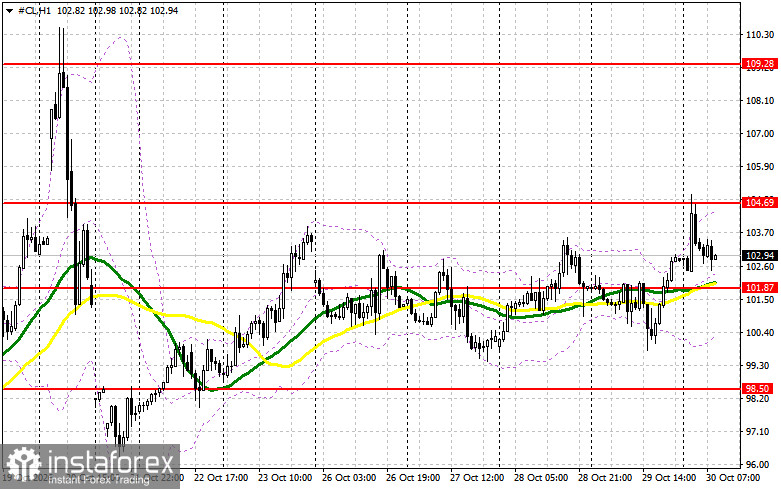
As for the current technical picture, buyers need to take the nearest resistance at $105. That would set up a target at $109, above which a breakout will be fairly difficult. The farther target is the $112 area. On a decline, bears will try to seize control of $101. If they succeed, a range break would deal a serious blow to bulls and push Oil down to $98, with a prospect of extending to $95.


