
Vea también


 17.11.2026 08:41 AM
Yesterday, the dollar found support on the Federal Reserve, although Chair Kevin Warsh said nothing about rates on Monday. At the FRB San Francisco conference, he discussed artificial intelligence and three scenarios for the US economy — from accelerating growth and productivity to market disappointment and a slowdown. The productivity and labor working group's recommendations are expected by year-end. Such caution is not new. In Bangkok in October, Warsh said he does not pre-judge meetings, and at the October 28 press conference he said more data are needed for the next decision.
His colleagues filled the chair's silence. Beth Hammack of the Cleveland Fed, who voted for a hike in October, said she prefers small, steady steps. But if an inflationary mindset takes hold — that is, if people and firms start living in anticipation of rising prices — the Fed will have to act more aggressively and reach a higher peak. She already sees early signs of tightening in the labor market. Futures currently price a hike on December 9 and another in January, so the Fed debate is about pace rather than whether to tighten.
All this creates an unfavorable backdrop for the euro. Yesterday eurozone industrial production rose only 0.2% versus a 0.3% forecast after a -0.5% drop in August, while the annual figure worsened to -1.5% from -1.1%. Today the euro faces three ZEW institute releases, and none promises strong support. ZEW surveys financial analysts assessing the economy's prospects over the next six months, so weak readings immediately hit investor expectations. The eurozone sentiment index is forecast at 19.1 after 18.5 in October; the German sentiment index at 28.8 versus 28.1; and the current situation assessment in the German economy is expected at -35.0 after -35.9. October's picture was unpleasant: eurozone sentiment fell to 18.5 versus a 24.2 forecast after 25.8, and the euro then declined; current assessments in Germany improved slightly, but expectations dominated. Now the market prices only a symbolic improvement while current conditions remain deeply negative. I believe that if the releases meet forecasts or come in weaker, pressure on EUR/USD will quickly return.
Now EURUSD stands at 1.1008, inside the range between 1.0988 and 1.1030. A move beyond the border is a breakout, but one touch is not enough—consolidation is needed, meaning several consecutive five-minute candles must close beyond the level. Otherwise, it is easy to get caught on a false breakout, after which the price will return.
From above 1.1030 is active. Consolidation above it opens the way to 1.1069 and then to 1.1102. Yesterday, price rose to 1.1031, nearly reached the level, but could not hold; this is a proven ceiling. The first target 1.1069 lies near Friday's high around 1.1062, so selling often occurs there. It is about 22 pips away, and ZEW is unlikely to justify a surge, so I have little faith in that scenario.
From below, the reference is 1.0988; consolidation below it leads to 1.0964 and then to 1.0939. I consider this direction primary. Overnight, the price fell to 1.0986, just below the level, but couldn't consolidate and moved back up, suggesting buyers are defending this zone. Therefore, a real breakout requires consolidation below, not another poke. It is about 20 pips away, and the first target is another 24 pips beyond that. If the price does that and consolidates, the drop could be quick. I would not enter on the first touch.
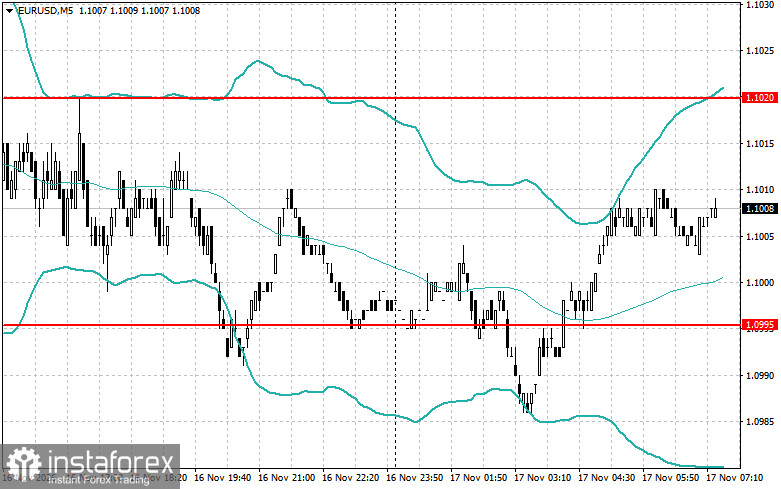
There are two levels here: 1.1020 and 1.0995. The upper reference 1.1020 lies inside the range, ten pips below the breakout point for buying at 1.1030. Yesterday evening, price nearly reached this mark and then fell back below. If something similar repeats, I consider selling toward 1.0995 with a stop above 1.1030 with a small margin, because consolidation above that point cancels the return idea. This picture is most likely if ZEW prints close to forecasts and the market retraces after the first reaction. If the price consolidates above 1.1020, the return is canceled, and the next reference becomes 1.1030, where the breakout is already working. The difference between the two scenarios may take several minutes to materialize, so it is better to skip the first reaction in the zone.
The lower reference 1.0995 lies seven pips above the breakout point for selling at 1.0988. This is exactly where the overnight return occurred. Price dropped to 1.0986, did not consolidate, and then returned higher, rising about 22 pips. With such a poke, a stop set exactly at 1.0988 would have been hit, so a buffer is essential. The scheme is this: the price falls to 1.0995, cannot consolidate below and returns above, and then I look to buy toward 1.1020 with a stop below 1.0988 with a small margin. Such a rebound is most likely if the Fed doesn't drop any new tough words and the market starts taking profits after the drop. If price consolidates confidently below 1.0988, the rebound is canceled, and the downward breakout works.


