
Vea también


 18.11.2026 08:55 AM
The World Bank has decided to test whether regulated stablecoins can replace the correspondent banking chain for development payments. On Tuesday, the group announced that, together with Citi and Circle, it will study US dollar-denominated stablecoins and blockchain rails that could operate alongside or improve the current system. Citi provides access to existing banking channels, and Circle supplies issuance and settlement in USDC. The goal is for payments to be faster, cheaper and more transparent for the Bank's clients.
According to the report, the backbone will be FundsChain, the Bank's blockchain platform for tracking how allocated funds are spent. More than 350 projects in 96 countries are now connected to it, whereas in September last year it was being tested on 13 projects in ten countries — so coverage has expanded many times over. The World Bank cites resource constraints as tasks become more complex, so small savings on each payment could free up significant sums at scale.
Importantly, this is just a study, not a launch. In the first phase, the Bank is examining an intermediary model and system compatibility, and it will work with borrowing countries where digital assets are supported and permitted. Later, the group may bring in other banks to broaden coverage. Citi emphasises its network spans more than 180 jurisdictions and offers round-the-clock payments, while Circle calls the initiative an example of responsible use of the technology. The announcement includes no timeline, volumes or choice of blockchain. In my view, those details will determine whether the idea becomes a working product.
Notably, the news arrived amid a contraction in the stablecoin market itself. According to Glassnode, on November 11, supply fell by $14.2 billion over 30 days to just under $280 billion, a level not seen since September 2025. In my view, speculative demand is leaving with price declines, while payments demand is increasing. On October 15, Visa Direct moved pre-funding of payouts in USDC from pilot to commercial operation; the next day Mastercard launched a BVNK-based platform that holds fiat and stablecoins in one account; and on Monday, Bundesbank and MAS demonstrated euro settlement versus the Singapore dollar on wholesale central bank digital currencies. Now a development institution whose projects on the platform cover 96 countries has joined them.
For Bitcoin's price, this news is secondary. On Monday, it fell below $65,000 after bouncing from a weekend low around $62,000, and stocks tied to AI remain the main drag. Nvidia's report beat expectations, with revenue of $115.8 billion versus roughly $109 billion forecast, and the board is not planning to return Jensen Huang to the CEO position. Today Anthropic sets its offering price, with trading to begin on Thursday, and I think the market will continue to take liquidity out of crypto.
All this suggests stablecoins are solidifying as payment infrastructure faster than Bitcoin is restoring investor confidence. I would not rule out the World Bank study turning into a pilot on selected projects over the next year, and USDC gaining additional institutional demand. But it will not affect Bitcoin's price. Until Anthropic's listing on Thursday, I expect Bitcoin to hold in the $62,000–$65,000 range with the risk of retesting the weekend low; a sustained reversal is possible only if ETF outflows stop and stablecoin supply ceases to shrink.
Technical analysis and recommendations
Bitcoin
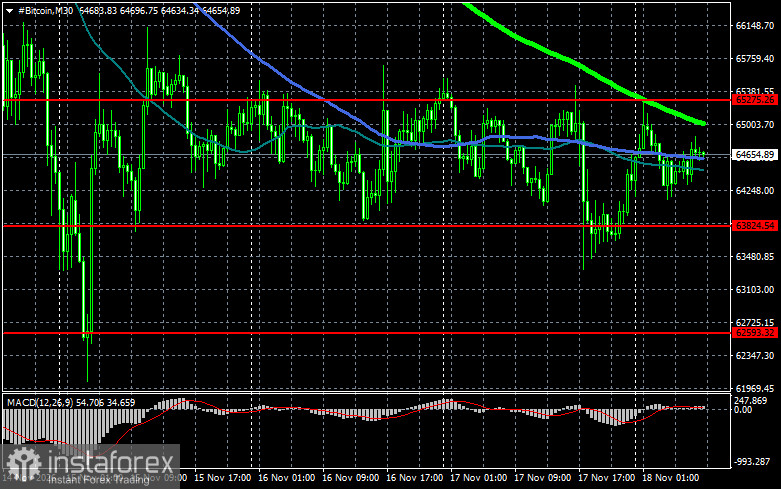
Buyers are currently targeting a return to $65,300, which opens a clear path to $66,500, and from there $68,200 is within reach — breaking that would signal attempts to resume a bull market. If Bitcoin falls, I expect buyers at $63,800. A drop back below that area could quickly push BTC toward $62,800. The most distant target would be the $60,600 area.
Ethereum
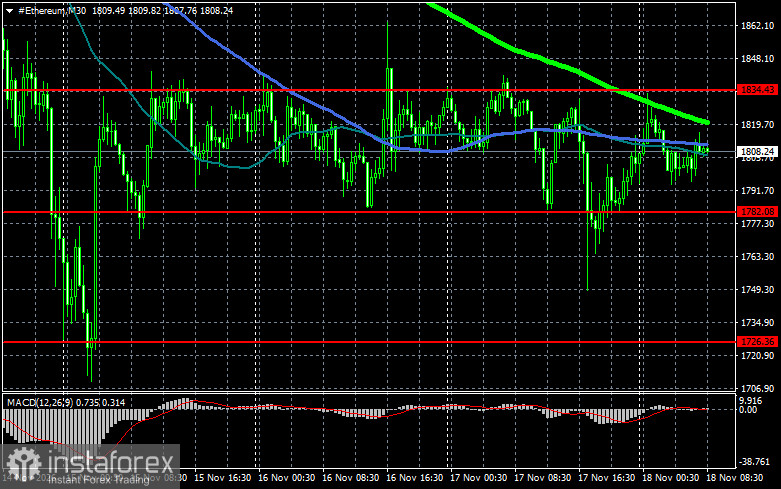
A clear hold above $1,834 opens a direct path to $1,872. The most distant target is the high around $1,916 — breaking that would indicate strengthening bullish sentiment and renewed buyer interest. If Ether falls, I expect buyers at $1,782. A return of the instrument below that area could quickly push ETH toward $1,726. The most distant target would be the $1,650 area.
Comments on the chart
Price testing or crossing any of these moving averages often either halts movement or injects fresh momentum into the market.


