
Vea también


 20.11.2026 08:01 PM
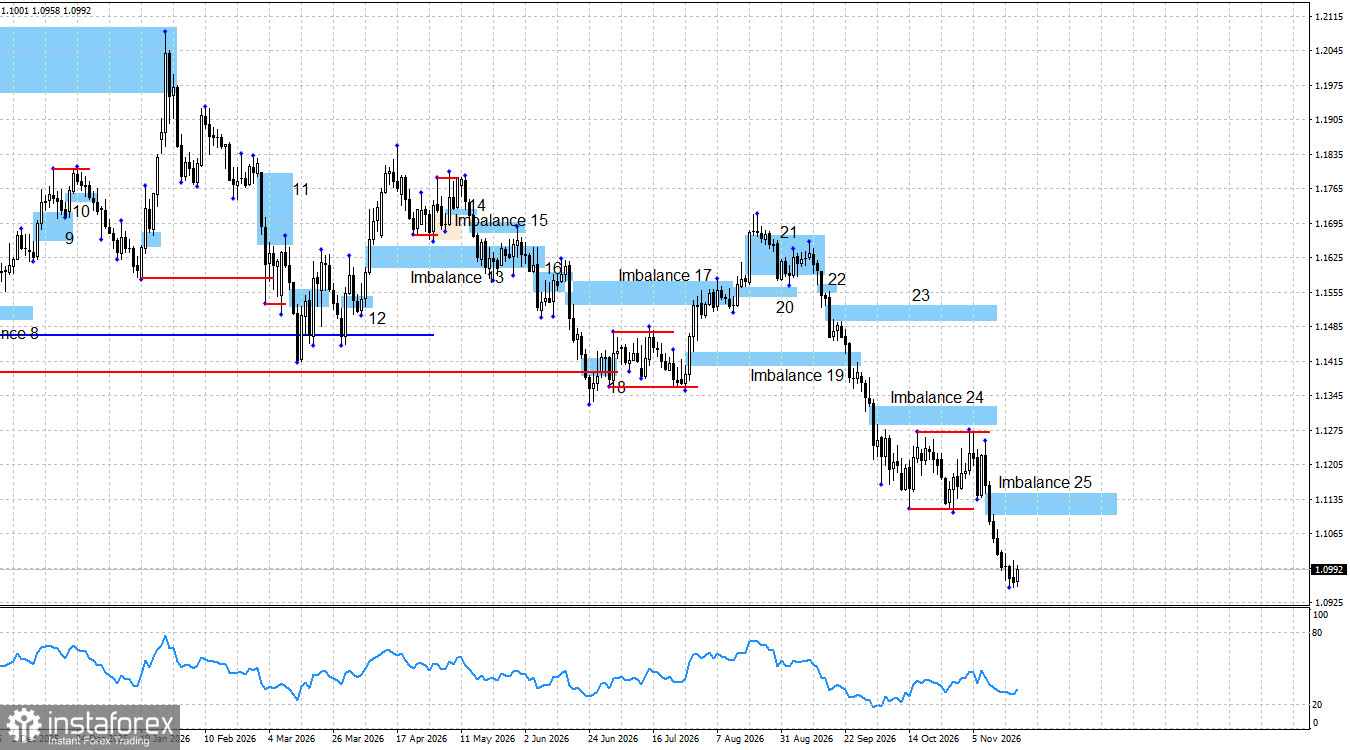
The EUR/USD pair declined for seven consecutive full trading days, losing a total of 260 points. Since the end of August, the euro has depreciated by 700 points in total. The latest decline in the euro began last week following a series of positive US economic reports. A strong US labor market, low unemployment, and elevated inflation brought the bears back into the market after they had remained in the background for an entire month. However, as it turned out, they had not simply been staying out of sight. They had been waiting for the right moment to strike. The bears were ready to act, while the bulls once again demonstrated their lack of momentum and inability to respond. Overall, there is little point in speculating about why the US dollar has continued to rise for the fourth consecutive month. All the most important economic reports were released last week or even earlier, yet the bears continue to attack this week. Traders have known for several weeks that the Fed will raise interest rates for the second time in December, so this factor can hardly be considered the actual reason behind the dollar's appreciation. The market continues to sell EUR/USD relentlessly, meaning that every new advance in the dollar cannot be attributed to specific events, reports, or news releases. Traders are quite satisfied with the explanation that "the dollar is rising because the FOMC is adopting a more hawkish monetary policy stance." Neither the dollar nor traders currently require anything more.
Over the past three months, the fundamental backdrop has frequently favored the euro, but this has had no impact on its exchange rate. The Republican Party suffered a decisive defeat in the elections, and Congress will now be divided. Democrats and Republicans find it extremely difficult to reach agreements and cooperate with each other. As a result, many important government decisions could face significant delays starting in January. The renewed increase in inflation in the European Union points to further ECB monetary policy tightening, just as rising inflation in the United States suggests further Fed tightening. ECB policymakers are speaking about the need for additional rate hikes just as their Fed counterparts are. If the market is pricing in FOMC monetary policy tightening, it should also be pricing in further ECB tightening. However, over the past few months, the usual cause-and-effect relationships have not been working for EUR/USD.
It is worth recalling that one of the main reasons behind the dollar's appreciation over the past three months has been the Fed's hawkish stance. However, in practice, this stance is not particularly hawkish compared with those of other central banks. For example, the ECB will deliver its third rate hike in December, while the Bank of England could implement as many as four full rounds of tightening. The pound has at least partially reflected these factors in its performance, whereas the euro has not.
At present, there is not a single indication that the bears' advance is coming to an end. Imbalance 24 remains valid, and the price has yet to react to it because even a corrective pullback in the euro has become a rare occurrence. A liquidity sweep below 1.1270, strong US labor market data, and elevated inflation triggered another wave of selling by the bears. Another bearish imbalance, Imbalance 25, formed last week. However, the euro must first reach this level before any new sell signals can be considered. The bulls, meanwhile, have little choice but to hope for a miracle or for the bears to retreat voluntarily.
Overall, the fundamental backdrop, in my view, continues to favor the bulls. Despite the Fed's increasingly hawkish monetary policy stance, it is not the only factor driving the currency market. There was virtually no economic news on Friday, apart from ECB President Christine Lagarde's third speech of the week. As in the previous two instances, the ECB President did not discuss monetary policy.
Economic Calendar for the United States and the European Union:
On November 23, the economic calendar contains six entries, and particular attention should be paid to the European PMI figures. Economic data may influence market sentiment on Monday.
In my view, the pair remains in the process of forming a bullish trend that has been interrupted by a corrective pause lasting an entire year. The fundamental backdrop shifted sharply in favor of the bears nine months ago, but the four-year trend itself cannot be considered invalidated or complete. The bulls could launch a new advance before the end of the year, but they currently lack any real opportunities to do so. There are no bullish patterns, no liquidity sweeps, and no other supporting signals. As for the bears, they have a new bearish imbalance (Imbalance 25). A reaction to this imbalance could provide opportunities to open new short positions targeting 1.0733.


