
Vea también


 23.11.2026 09:51 AM
The wave structure of the EUR/USD 4-hour chart has become more complex. On the higher timeframe (bottom chart), the downward trend segment has taken the form of a five-wave structure A-B-C-D-E, which may be completed at any moment, as it appears structurally complete. All the waves within this segment are approximately equal in size, which is why it is considered corrective. If this assumption is correct, once this structure is complete, a new impulsive upward trend segment will begin, with targets located well above the 1.2000 level.
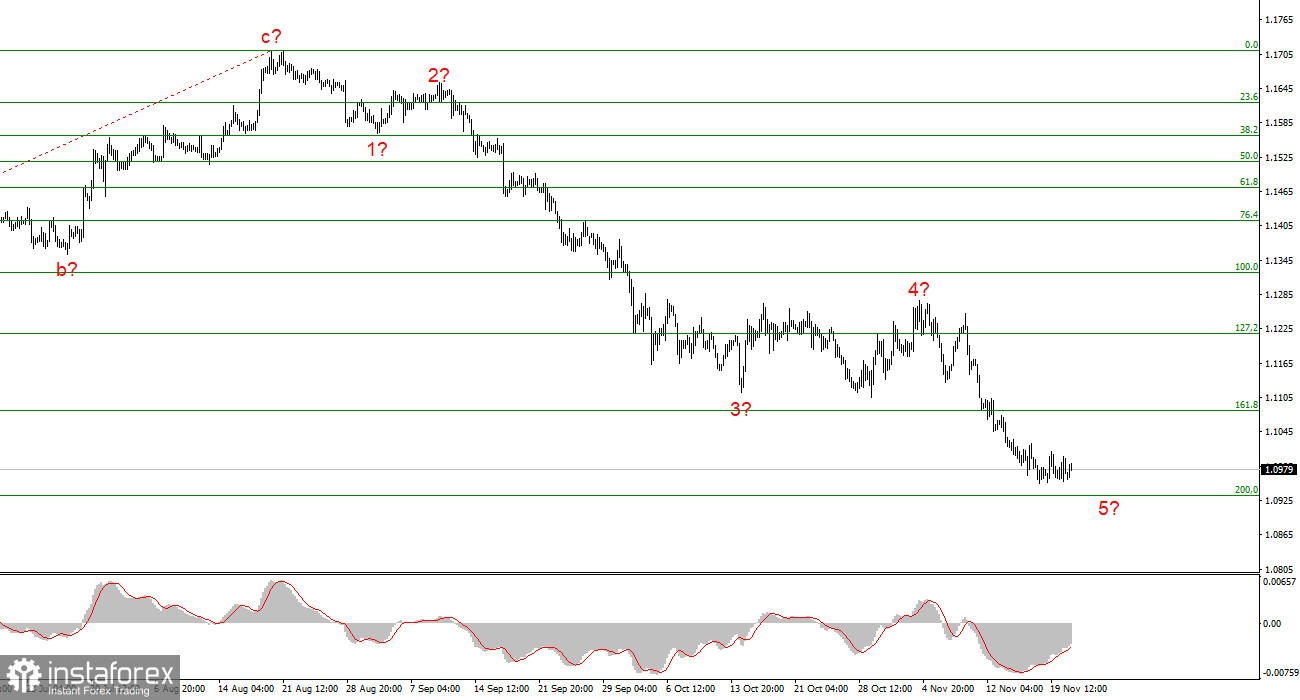
On the lower timeframe (top chart), an impulsive wave structure continues to develop, which may belong to wave E of the higher timeframe. If this is indeed the case, the dollar's strengthening is nearing its end, regardless of how much further the US currency may appreciate. The expected wave 5 within wave E is approaching completion. In any case, the current wave structure suggests that the downward wave sequence is nearing completion on both charts. News developments and a sharp shift in market sentiment have led to a significant appreciation of the US currency, but there are few remaining reasons for further dollar strength.
The dollar has no fundamental reasons to rise, yet it continues to appreciate.
The EUR/USD exchange rate remained unchanged on Friday, but this is hardly a glimmer of hope for the European currency. Overall, the euro continues to decline, and the occasional, insignificant pauses have done little to change the situation. Therefore, only one outcome can be expected at the start of the new week: another decline. A closer look at the lower timeframe chart reveals only three waves within wave 5. Meanwhile, the most recent three-month trend segment is clearly impulsive. Consequently, wave 5 should consist of five waves. This means that at least one more downward impulse is expected. The sooner it occurs, the better.
The new week will begin with the release of business activity indices for Germany, the European Union, and the United States. All six key indices are above the critical 50.0 threshold, so no sharp changes in the trends observed over recent months are expected. The indices may decline slightly or rise slightly, but the overall trend is likely to remain positive. This means that neither the dollar nor the euro should expect significant support from these releases today. The dollar's rally should have ended long ago, while the European currency may experience at least one more decline as part of wave 5 of wave 5 within wave E. Consequently, the short-term outlook remains bearish, while the medium-term outlook is bullish.
It is also worth noting that the overwhelming majority of economists and major banks are also forecasting a recovery in the European currency. Many experts point out that the euro declined too sharply in the second half of 2026 and that every trend is eventually followed by a correction. Therefore, the baseline scenario for next year is a recovery toward $1.18. This scenario appears reasonable, and the only remaining question is when the trend reversal will occur.
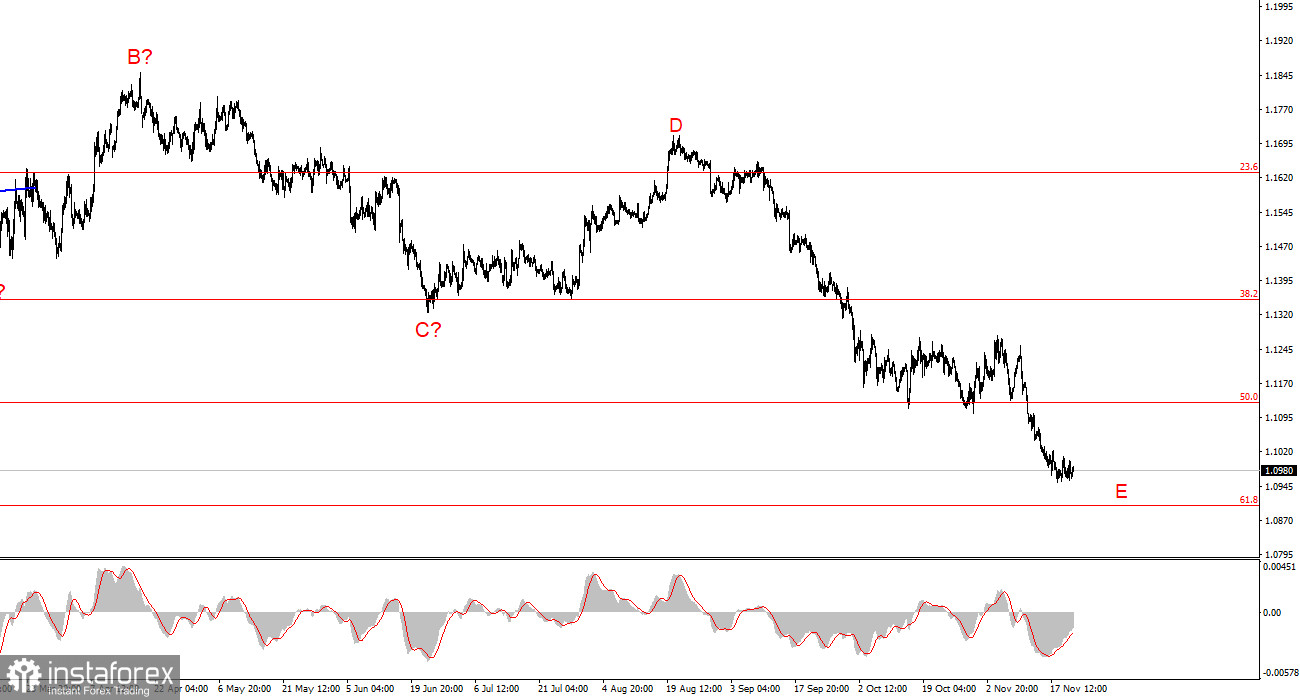
Based on the EUR/USD analysis, the instrument is considered to remain within the global corrective trend structure A-B-C-D-E. However, this structure appears fully developed and may be completed at any moment. Current conditions appear favorable not only for buying the European currency but also for anticipating the development of a full-scale upward trend segment. According to the higher timeframe analysis, the exchange rate is expected to rise to at least the 1.1700–1.1800 level. The stronger the instrument declines now, the stronger its subsequent recovery may be. However, confirmation is still needed that the downward wave sequence has been completed. One possible signal would be an unsuccessful attempt to break below the 1.0902 level, corresponding to the 61.8% Fibonacci retracement level on the higher timeframe.
The higher timeframe chart shows a downward trend segment that has taken the form of an A-B-C-D-E structure. The internal wave structure of wave E has developed into a five-wave impulsive pattern, which may already be complete. If this assumption is correct, a new upward trend segment will begin in the near future.
The Main Principles of the Analysis:


