
Vea también


 23.11.2026 10:07 AM
The single European currency generally accomplished the task set for it at the end of last week: buyers defended the weekly low around 1.0956, which was a good entry point for long positions. Consolidation continues in a sideways channel between 1.0956 and 1.1010 with a midpoint near 1.0984; the picture on the pound sterling is the same. By way of comparison, on Friday morning, EUR/USD traded near 1.0980 and is now at 1.0984, while GBP/USD rose from 1.3106 to 1.3111 — in other words, the instruments barely moved over the weekend. Notably, Friday's releases did not provide support, even though both beat expectations. UK retail sales for October rose 0.7% versus an expected flat reading, and German producer prices increased 1.4% versus forecasts of 0.9% and 1.9% the month before.

Meanwhile, the Fed remains poised to continue rate hikes. At the end of last week, Anna Paulson said the FOMC could raise interest rates at least a few more times; on November 10, she spoke only of further gradual tightening, and before that, she emphasized clarity in communications. A December rate increase is now priced at better than 97% probability, up from 96.3% after Waller's remarks on November 10. Further steps are expected in January and March next year. Importantly, some Fed officials advocate for more rate hikes, even though recent inflation readings, albeit preliminary, point to a modest slowdown. Why isn't the dollar extending its gains? I believe it's because the tightening is already priced in, and fresh signals from oil and inflation expectations are pulling in the opposite direction.
The energy market picture has improved as well: the Middle East war has entered a calmer phase, transit through the Strait of Hormuz has been restored, and many countries are using alternative routes — all of which helps push prices down, as is visible in oil price charts. I would add that this changes central banks' calculations. On November 5, Bailey said a second Bank of England hike was more likely than not if energy prices returned to prior levels; in my view, that argument weakens with the current oil slump, whereas Nagel insisted that inflation must be fought even if energy becomes cheaper.
As for today, preliminary euro-area business activity figures for November are released in the first half of the day. The manufacturing PMI is forecast at 52.7, the same as in October; the services PMI is expected at 51.8 versus 51.4, and an improvement in services is notable because the October flash was weak — after it the euro fell sharply, and the final composite index of 51.7 was the first decline since May. For Germany, manufacturing is expected at 54.1 and services at 52.4; for France, 49.8 and 47.4, meaning French services remain in contraction. Even if these are preliminary values, good data could support the euro in the morning and continue the correction we did not see at the end of last week.
Similar November data are released for the UK: manufacturing and services PMIs are both forecast to rise to 53, above the final October readings of 52.8 for both. The October services flash was 53.1 — an eight-month high, but the final print was weaker, so it will be interesting to see whether improvement is confirmed. In addition, Huw Pill will speak; he voted for immediate tightening alongside Greenspan and Mann. His hawkish tone could support the pound in the morning.
US activity data for November are also due: manufacturing is forecast at 54.5 versus 54.9 in October, and services at 55.6 versus 56.1. That is slightly worse than October, but the levels remain very high, so don't expect a small slowdown in expansion to greatly weaken the dollar versus the euro and the pound. Recall that on Thursday the Philly Fed index was 6.3 versus a forecast of 20.6, and initial jobless claims rose to 203k versus a forecast of 198k, yet the euro and pound stayed within their channels.
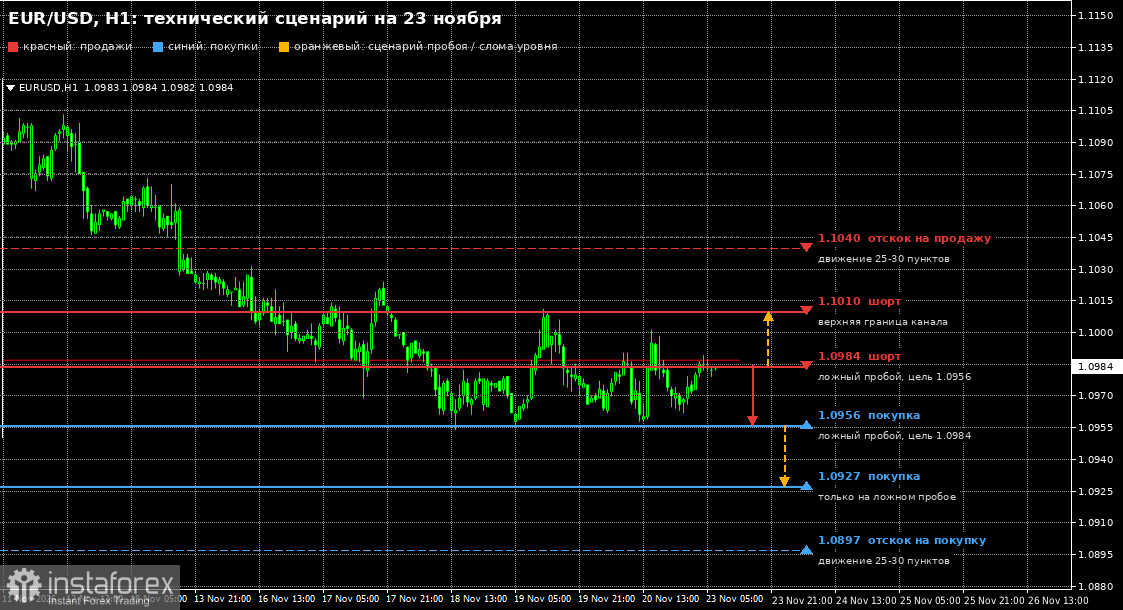
Technical picture for EUR/USD
On the 1-hour chart, a breakout with a close above 1.0984 would be a buy signal. That would give momentum toward 1.1010, with a further target around 1.1040, where I would look to sell on a retracement for moves of 25–30 pips. I open short positions from the upper channel band at 1.1010 or after a false breakout and a return below 1.0984, which would increase pressure on the euro and open the way to the weekly low at 1.0956. Aggressive buyer activity on a false breakout would provide a chance for longs, at least aiming for a return to 1.0984, with a more distant target around 1.0927 where buys on a false breakout are also possible, or buys on a dip from 1.0897 aiming for 25–30 pips. Compared with Friday, the levels have not changed — unsurprising, since the pair barely moved over the weekend.
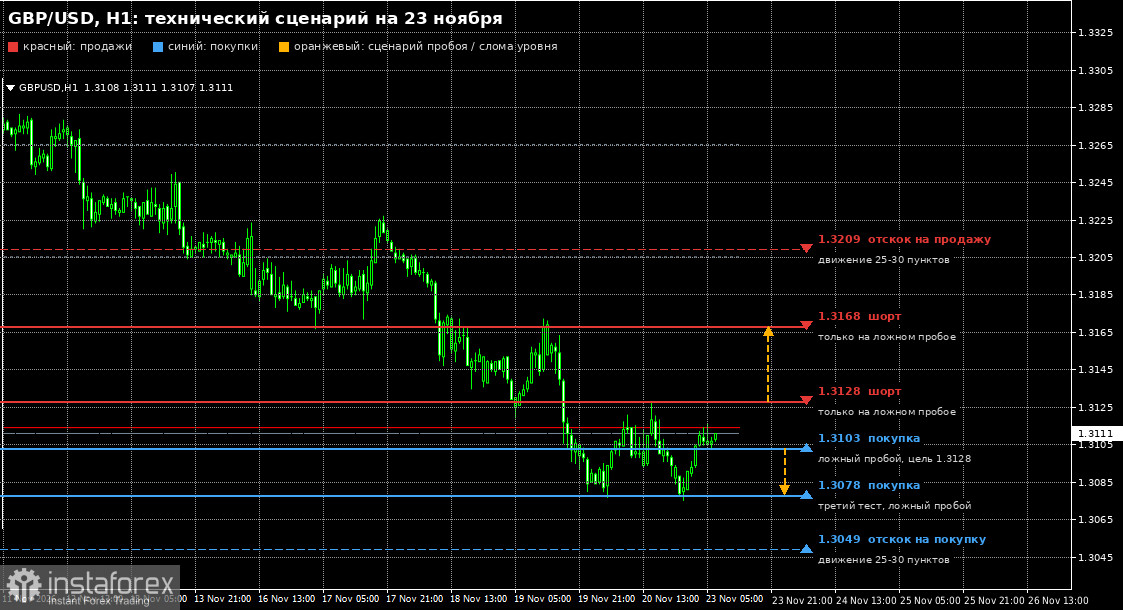
For GBP/USD, the story is exactly the same. A false breakout at 1.3103 offers a buying opportunity targeting 1.3128, while a breakout with a close and a successful retest of that zone on good UK data would be a reason to add to longs targeting 1.3168. A further target is 1.3209, where I would look to sell on a retracement for moves of 25–30 pips; I open shorts from 1.3168 and 1.3128 only after a false breakout. If bears take 1.3103, a return to 1.3078 is more likely, and a third test of that level with a false breakout would be a condition for longs; I consider buys on a rebound from 1.3049 aiming for 25–30 pips. Upper targets remain the same, while lower levels have been raised by 19–40 pips compared with Friday (which were 1.3084, 1.3038 and 1.3013), since the currency pair held above recent lows.
The overall picture remains neutral. I lean toward the view that until the preliminary PMIs and Pill's speech, the instruments will continue to consolidate within their channels, because the dollar has both support from Fed expectations and a break from falling inflation expectations and cheaper oil. I believe the main test for the euro will be whether good euro-area data can push the EUR/USD pair above 1.0984, since the ECB is promising nothing beyond December. The pound's only reason to rise today is the PMI and Pill's remarks. I do not rule out that a serious move may have to wait for the Fed meeting on December 9 and the ECB meeting on December 17; until then, the market is likely to trade off the channel bands.


