
Vea también


 24.11.2026 01:43 PM
The pound has recovered roughly half of yesterday's drop, but there's no compelling fundamental reason for it. From the morning high near 1.3142 to the low around 1.3010, the pair lost about 130 pips; today it jumped to 1.3070 and now trades near 1.3064. To me, the rise looks like a technical pause. No major UK data were released, and after the sharp fall, traders used the opportunity to close some short positions.
Today U.S. data will determine whether the dollar regains lost ground. The main release is the Conference Board consumer confidence index. Household spending is the primary engine of the U.S. economy, so this figure matters. The consensus is 92.4 versus 91.7 previously. For context, in September the index was 84.2 (the October forecast had been 81.2), and then it jumped 7.5 points partly because gasoline prices fell.
Also due are Case-Shiller home prices for 20 major cities (yearly growth was 2.7% in August), the FHFA house-price index (up 0.3% m/m in August), and the Richmond Fed manufacturing index (a regional factory survey where readings above zero indicate expansion; it was -2.0 in September and October). Housing data will show how the market is coping with mortgage rates near 7.2%.
I expect sellers will return, especially if U.S. figures print stronger than forecasts.
Now GBPUSD sits at 1.3064, inside a narrow range between 1.3049 and 1.3078 — about 15 pips above the lower boundary and 14 pips below the upper. The range is tight, which means false breakouts will be common. A move beyond the boundary is only counted as a breakout after confirmation — several consecutive five-minute candles closing beyond the level — because a single poke proves nothing.
On the upside, 1.3078 is the active level. A confirmed close above it opens the way to 1.3109 and then to 1.3140. Today's high near 1.3070 stopped about eight pips short of the level. The zone is familiar: on Friday evening the pair fell to 1.3075, and yesterday evening it rose to about 1.3078, so former support has become resistance. The first upside target, 1.3109, lies near yesterday's daytime level around 1.3112; the second, 1.3140, almost matches yesterday's morning high near 1.3142 — both zones are likely to meet sellers. To reach those levels would probably require weak U.S. data, a scenario in which I have low conviction.
On the downside, the reference is 1.3049; a confirmed close below it leads to 1.3013 and then to 1.2974. I treat this direction as primary. That level was resistance for a long time: overnight price only reached about 1.3047, and yesterday evening it poked to 1.3051, so today's move above it looks like a false breakout so far. If price consolidates below 1.3049, today's rise will likely be just a retracement without continuation. For context: on November 10 the pair traded near 1.3449; on Friday evening around 1.3075; yesterday morning about 1.3142; yesterday evening about 1.3010; this morning about 1.3028; and now 1.3064 — the overall downtrend remains intact. It is about 15 pips to the lower boundary, and another 36 pips from there to the first downside target at 1.3013, which corresponds to yesterday's low. I would not enter on the first touch.
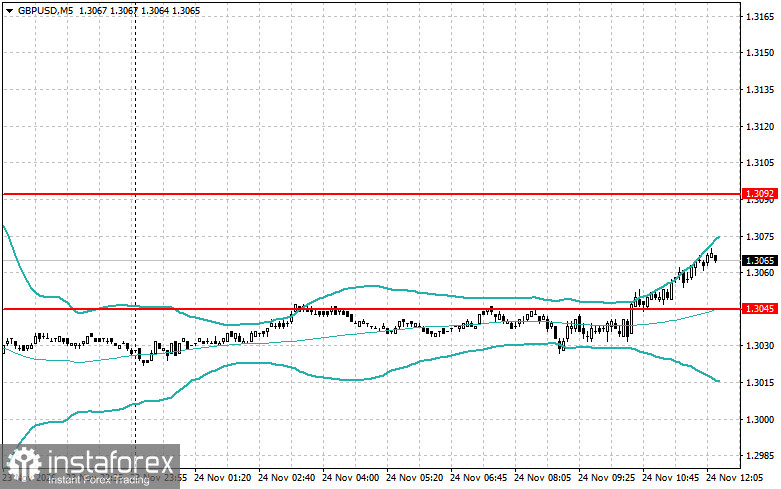
There are two levels here: 1.3092 and 1.3045. The upper reference, 1.3092, sits 14 pips above the upside breakout point at 1.3078 and about 28 pips above the current price. If the price has consolidated above 1.3078, it can quite plausibly run through 1.3092, so do not sell on a single touch there. If, however, the price reaches 1.3092, finds no continuation and quickly returns lower, I would consider selling toward 1.3045 with a stop above 1.3098 — i.e., just above the level with a small margin. That setup is likely if U.S. confidence prints near consensus and the market retraces after the initial reaction. The difference between the scenarios may take a few minutes to resolve, so it's best to skip the first reaction in the zone.
The lower reference, 1.3045, lies four pips below the downside breakout point at 1.3049 and about 19 pips below the current price, so it will be reached before a confirmed break lower. The overnight high near 1.3047 is nearby and has already acted as a reversal point. The scheme is: price closes below 1.3049, falls to 1.3045, cannot hold there and returns higher — then I look to buy toward 1.3092 with a stop below 1.3039. A buffer is essential because price often dips a few pips beyond the level. A rebound is likely if U.S. figures do not surprise and no new hawkish Federal Reserve comments appear. If price consolidates convincingly below 1.3045, the rebound is canceled, and the downward breakout to 1.3013 is in play.


