
Vea también


 25.11.2026 10:03 AM
The Conference Board consumer confidence index jumped 11.4 points in November to 103.3, marking the highest reading since January 2025 and surprising economists across the board. By comparison, the revised October print was 91.9 (initially 91.7), and September's read was 84.2, the lowest in more than a decade amid high food and energy bills. In two months, the index has risen roughly 19 points.

Both subcomponents improved. The present conditions index rose 13.7 points to its strongest level since July 2025, while the six-month expectations gauge moved to its best level since late 2024. For context, in October, present conditions were 120.4, and expectations were 72.6. More consumers now rate business conditions as good and expect improvement, and labor market assessments, both current and forward-looking, have become noticeably more positive.
The labor market remains the main pillar. The share of consumers saying jobs are plentiful rose to 30.8%, while those saying jobs are hard to find fell to 18.4%. The diffusion between the two, a closely watched signal, widened to 12.4 points, the largest gap since mid-2025. That aligns with official data: October nonfarm payrolls rose 165k versus a 65k consensus, and the unemployment rate fell to 4.1% from 4.2%.
Falling gasoline prices helped. AAA's national average slid from about $4.12/gal in early November to roughly $3.75 by mid-month (and the survey recorded $4.12 on November 6). Gasoline expectations fell after the election. That move tracks the oil market — Brent has dropped roughly one-fifth from $116.06 on October 30 to around $92 — and the personal finances component rose to its highest level since July. Conference Board confidence in October improved to 91.7 from 84.2 in September.
Household pressures persist, however. Economists estimate headline consumer prices were roughly 4% y/y in October vs. 3.7% in September, and core CPI for October was 0.3% m/m (consensus 0.2%), the third month in a row above expectations.
For the Fed, these prints are an additional argument for policy tightening. The funds rate currently sits at 3.75–4.00%. Markets price in a 25-bp hike at the December 8–9 meeting, and New York Fed President John Williams on November 23 did not rule out consecutive rate hikes if needed. A strong consumer and an improving labor market reduce the odds of a pause, particularly with the October PCE price index due this week and the November jobs report on December 4.
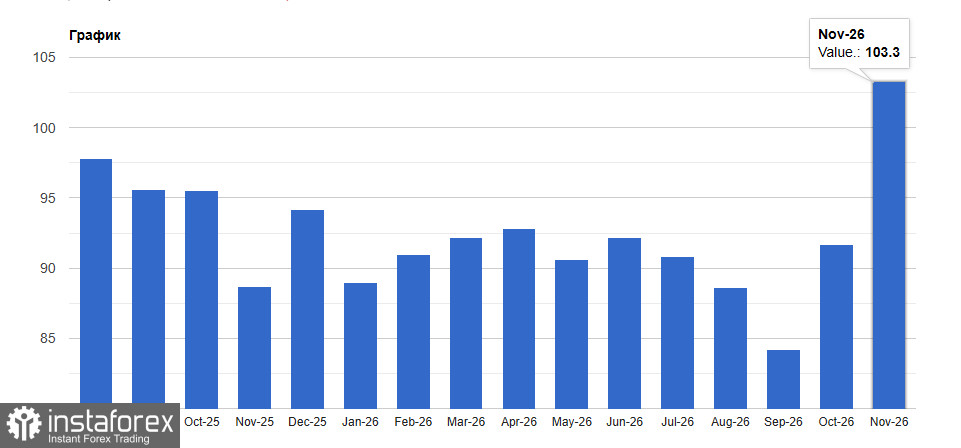
My view is that US consumer optimism should support the dollar and December rate hike expectations in the coming weeks. The key test will be the November payrolls report on December 4. If it confirms further labor market improvement, the confidence surge could mark the start of a more durable trend. If not, the bump may prove short-lived into year-end.
EUR/USD
Buyers should consider taking 1.0960. Only that would open a test of 1.1005. From there, a run at 1.1040 is possible, but doing so without support from large players will be difficult. On a pullback, I expect increased buying activity only near 1.092. If bids are absent there, wait for a dip to a fresh low at 1.0880 or consider long positions at 1.0850.
GBP/USD
Pound buyers need to overcome the nearest resistance level of 1.3100. That would enable a move toward 1.3140, above which further gains would be challenging. The next upside target is around 1.3175. On a decline, bears will try to take 1.3060. If they succeed, a break below that level would deal a serious blow to bulls, pushing GBP/USD to 1.3015, with the prospect of extending weakness to 1.2975.


