
Vea también


 27.11.2026 04:55 AM
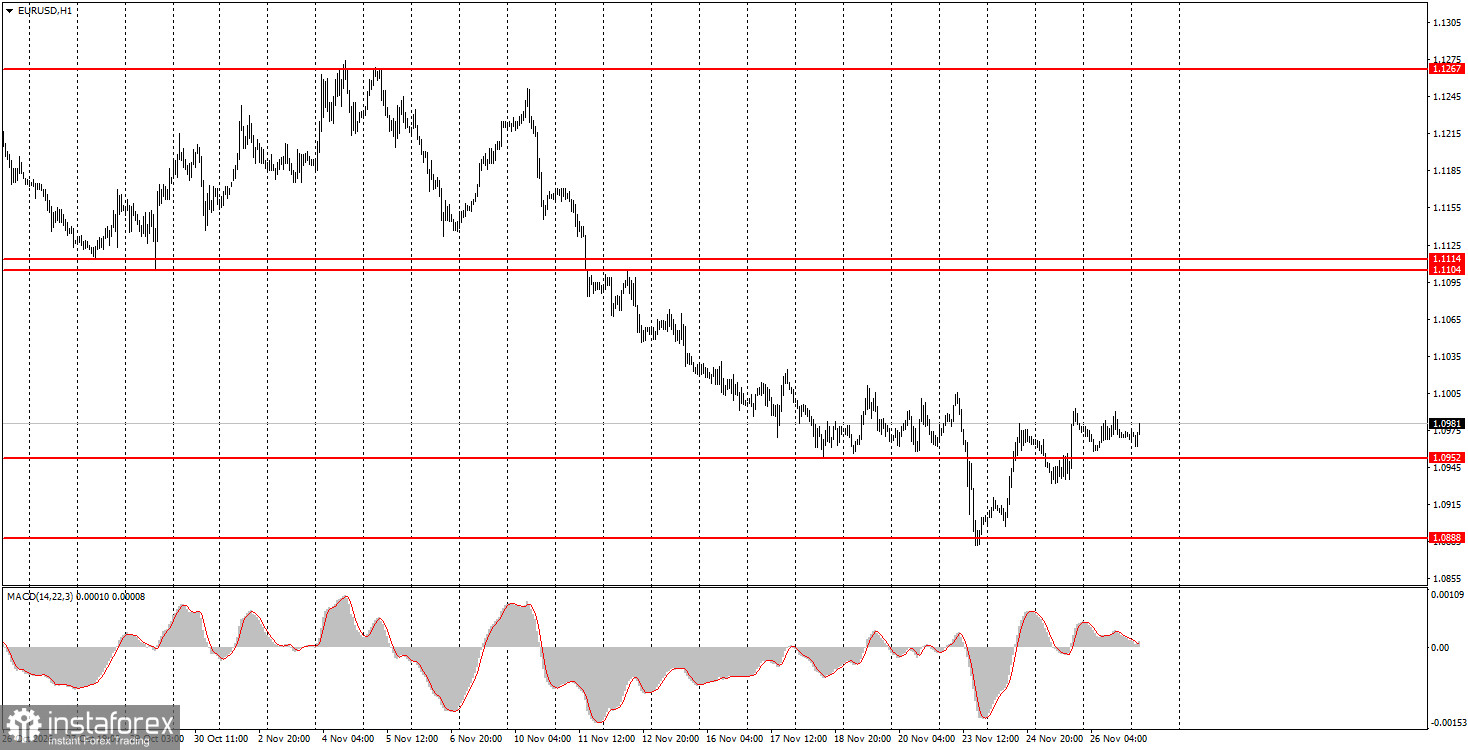
The EUR/USD pair showed absolutely no movement on Thursday. The price traded with minimal volatility and without a clear direction all day because there were no important events in either the euro area or the United States. Yesterday the US observed Thanksgiving and all stock exchanges and trading venues were closed. Today the holiday will likely continue, so high volatility is not expected. The euro against the dollar remains near the market bottom and has only in the last few days managed to pull slightly away from one-and-a-half-year lows. Does this mean the downtrend is over? Judging by the current technical picture and market sentiment, no. At the same time, any rise in the euro would be natural, since over the past three months it hasn't really corrected, remains extremely oversold and arguably cheap, and the market has ignored bullish factors for three months.
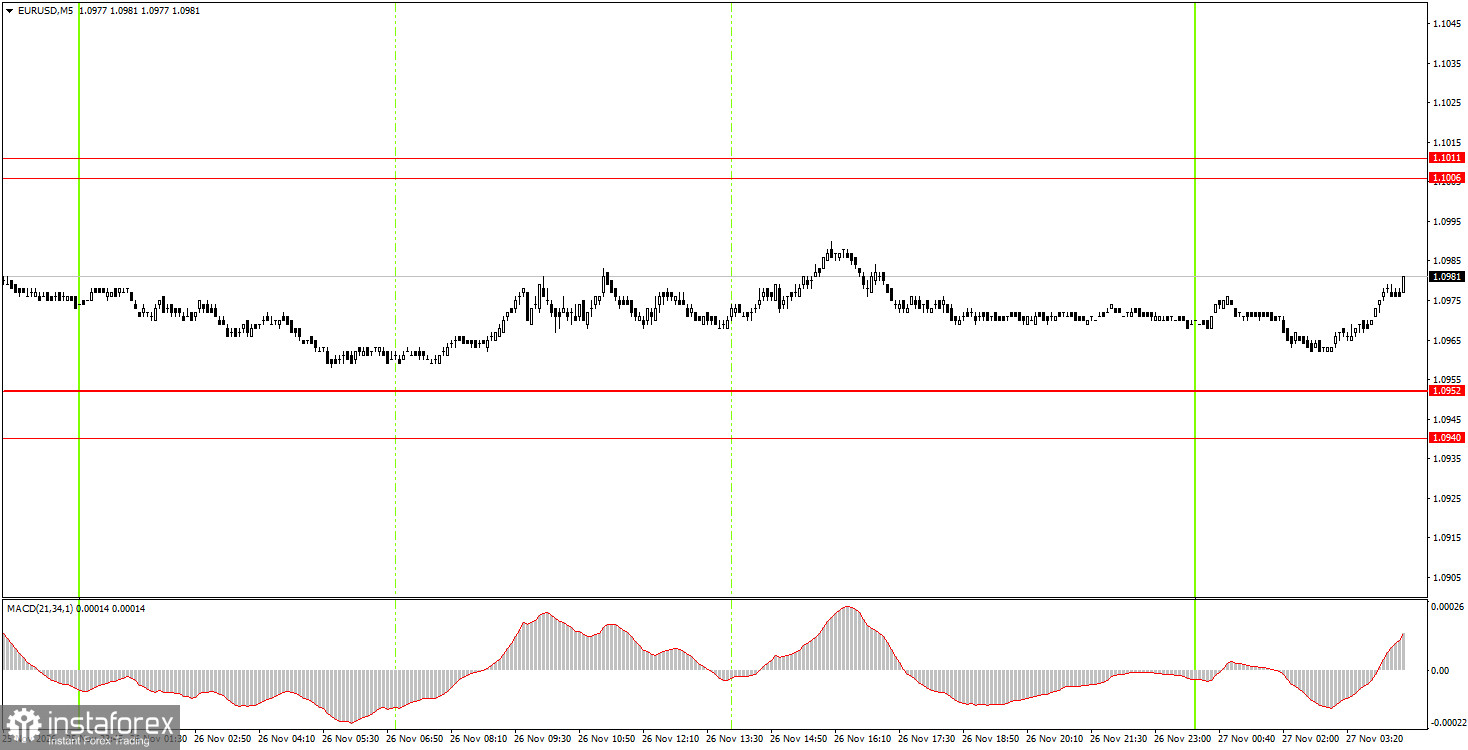
On the 5-minute timeframe, no trading signals formed on Thursday because the pair traded sideways all day with minimal volatility. None of the levels or zones worked out.
On the hourly timeframe, EUR/USD continues forming a downtrend that has lasted more than three months. The euro has not once managed even a proper correction during this period. Given recent months, we do not believe the euro had grounds for such a strong fall with virtually no correction. At the moment, the dollar is heavily overbought, and many factors in favor of the euro are being ignored.
On Friday, novice traders may consider short positions if the pair rebounds from the 1.1006–1.1011 area, targeting 1.0940–1.0952. Open long positions on a rebound from the 1.0940–1.0952 area, targeting 1.1006–1.1011.
On the 5-minute timeframe consider the levels 1.0797–1.0804, 1.0859–1.0861, 1.0888–1.0896, 1.0940–1.0952, 1.1006–1.1011, 1.1104–1.1114, 1.1198–1.1218, 1.1267–1.1275, 1.1366–1.1377, 1.1461–1.1474. On Friday, Germany will publish the unemployment rate, and that is the only important event scheduled for the day. Thus, volatility may again be low.
Price levels (areas) of support and resistance — levels that serve as targets when opening longs or shorts or as sources of signals.
Red lines — channels or trendlines that display the current trend and indicate the preferred trading direction.
MACD indicator (14,22,3) — histogram and signal line — an auxiliary indicator that can also be used as a source of signals.
Important speeches and reports (listed in the news calendar) can strongly affect a currency pair's movement. Therefore, when they are released, one should trade as cautiously as possible or step aside to avoid a sudden price reversal against the prior direction.
Beginner forex traders should remember that not every trade can be profitable. Developing a clear strategy and money-management rules is the key to long-term success in trading.


