
আরও দেখুন


 25.02.2026 04:53 AM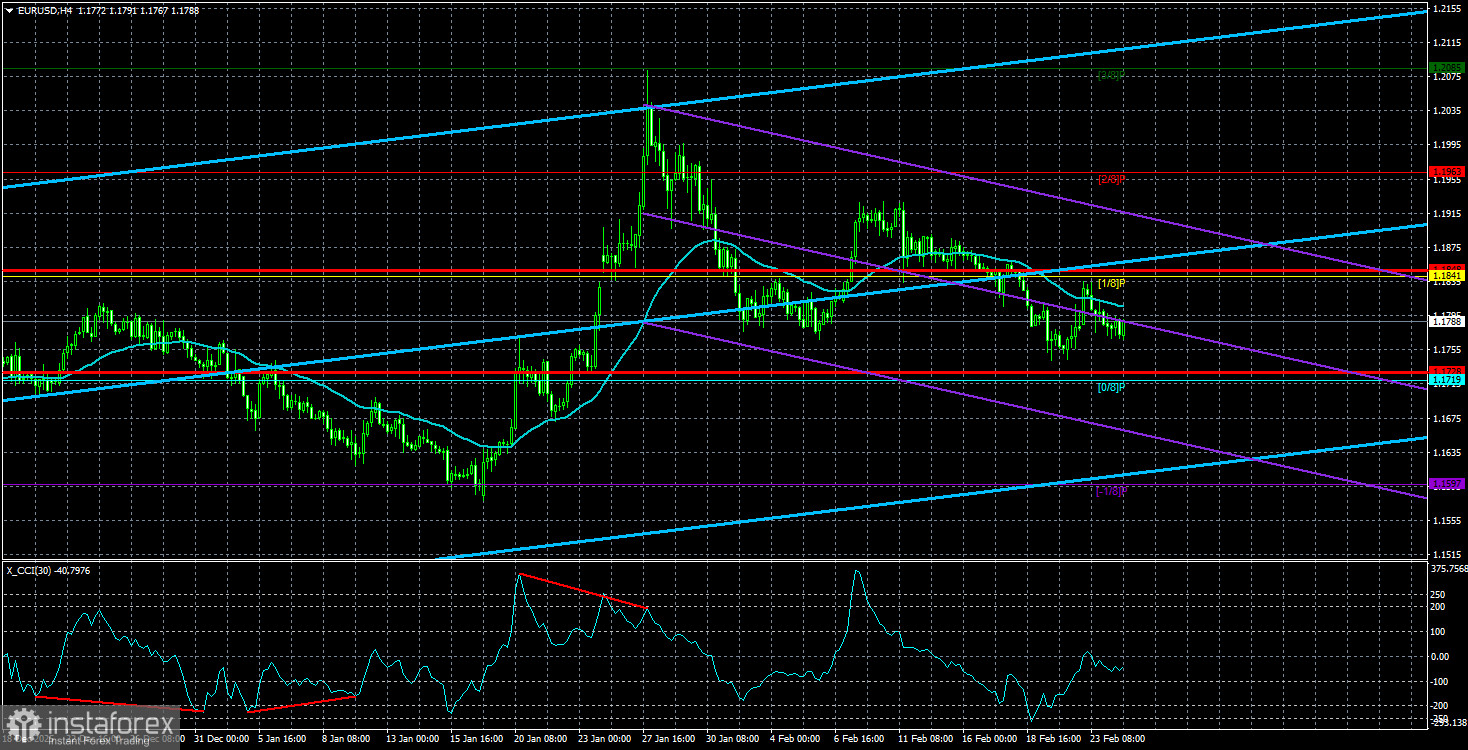
The EUR/USD currency pair has again traded as if there has been absolutely no news in recent days. To recap (though there may be no particular need), the U.S. Supreme Court annulled all of Trump's global tariffs, to which Trump responded by imposing new tariffs of 10% on "everyone," threatening to raise them to 15% soon. Looking at the charts and volatility diagram, one gets the impression that there have been no significant updates for the past two weeks. During this time, the dollar has slowly climbed. This growth is not strong enough to be taken seriously or respected; meanwhile, it is a rise in the dollar when its decline would make much more sense.
So, we can begin to speculate why the market is refusing to sell the American currency. The first thought that comes to mind is a potential U.S. invasion of Iran. Rumor has it that the next round of largely formal negotiations between Tehran and Washington is scheduled for this week, and if there is no breakthrough, Trump will be ready to give the order to commence military operations. We call the negotiations "formal" because no one has managed to reach an agreement with Iran over the last 50 years. For the past 50 years, the country has lived like a powder keg. Military actions flare up with renewed vigor and then quiet down. The country is effectively on the verge of economic collapse, with the value of the Iranian rial plummeting to zero. Yet none of this has persuaded Tehran to abandon its nuclear program.
Thus, we believe that the likelihood of reaching an agreement with Trump is zero. There will be military conflict; the only question is how significant it will be. At the same time, one of the few reasons for the U.S. dollar's growth in recent weeks is, in fact, the market's expectation of this very conflict. Accordingly, this factor has likely already been priced in or is close to being so. However, there are no supporting factors for the dollar. There are, on the other hand, plenty of factors weighing down on it that the market has been rigorously ignoring lately, starting from the disappointing GDP report, the quite contradictory Non-Farm Payrolls (NFP), falling inflation, and ending with Trump's actual refusal to comply with the Supreme Court's ruling and a new escalation of the trade war, which has already led to a freeze in the ratification of agreements with India and the European Union.
We do not believe the market is obligated to reverse at times we deem necessary, or at any specific period. However, we believe the dollar's decline in 2026 is inevitable. The higher the dollar rises now, the more it will fall later. The lower the EUR/USD pair descends, the greater the likelihood that this movement will end very soon. However, as the market has largely ignored the vast majority of macroeconomic and fundamental events over the last two weeks, we advise traders not to overlook the technical picture. Expecting a new rise in the pair is best done after breaking the trends on the hourly and four-hour timeframes.
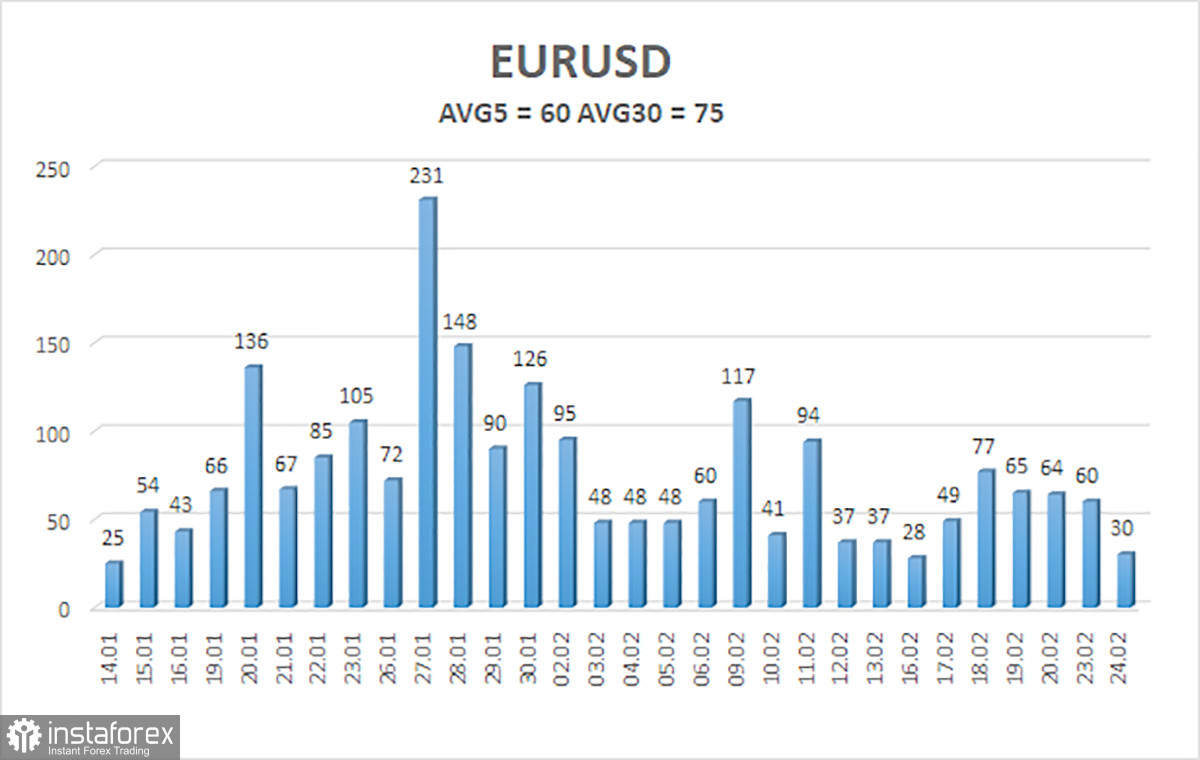
The average volatility of the EUR/USD currency pair over the last 5 trading days as of February 25 is 60 pips, which is considered "average." We expect the pair to trade between 1.1728 and 1.1848 on Wednesday. The upper channel of the linear regression points upward, indicating further growth for the euro. The CCI indicator has entered oversold territory, signaling a potential resumption of the upward trend.
The EUR/USD pair continues to correct within the upward trend. The global fundamental background remains extremely negative for the dollar. The pair has spent seven months in a sideways channel, and it is likely time to resume the global trend of 2025. The dollar has no fundamental basis for long-term growth. Therefore, all the dollar can hope for is a sideways move or corrections. When the price is positioned below the moving average, one may consider small shorts with targets at 1.1728 and 1.1719 on purely technical grounds. Above the moving average line, long positions remain relevant with targets at 1.1963 and 1.2085.


