
See also


 27.10.2026 04:44 AM
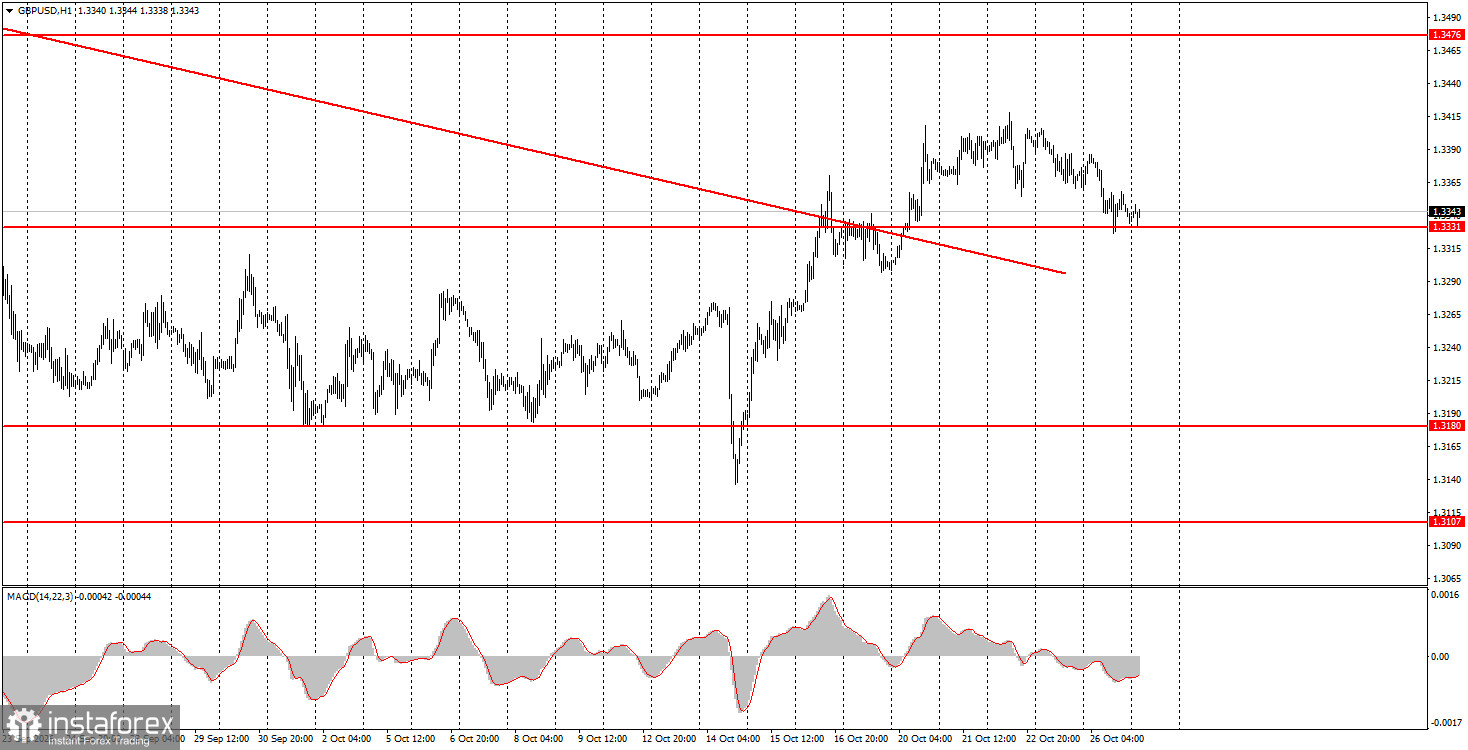
The GBP/USD pair continued downward on Monday, which can be viewed as a routine technical correction after a fairly strong rally. No fundamental or macroeconomic factors drove the pound lower on Monday. Yes, geopolitical tension is rising again and is driving some traders into the safe-haven dollar, but geopolitical risk has been elevated for about five years—it cannot alone justify every dollar move. In reality, the U.S. under Trump does not look like a model of stable economics and predictable policy; rather, the opposite. The market keeps ignoring many factors that support sterling.
We remain biased toward sterling's recovery, at least on technical grounds. Recall that sideways channels persist on the daily and weekly timeframes: two weeks ago, price tested the lower boundaries of those channels, formed a deviation, and can now move toward the upper boundaries.
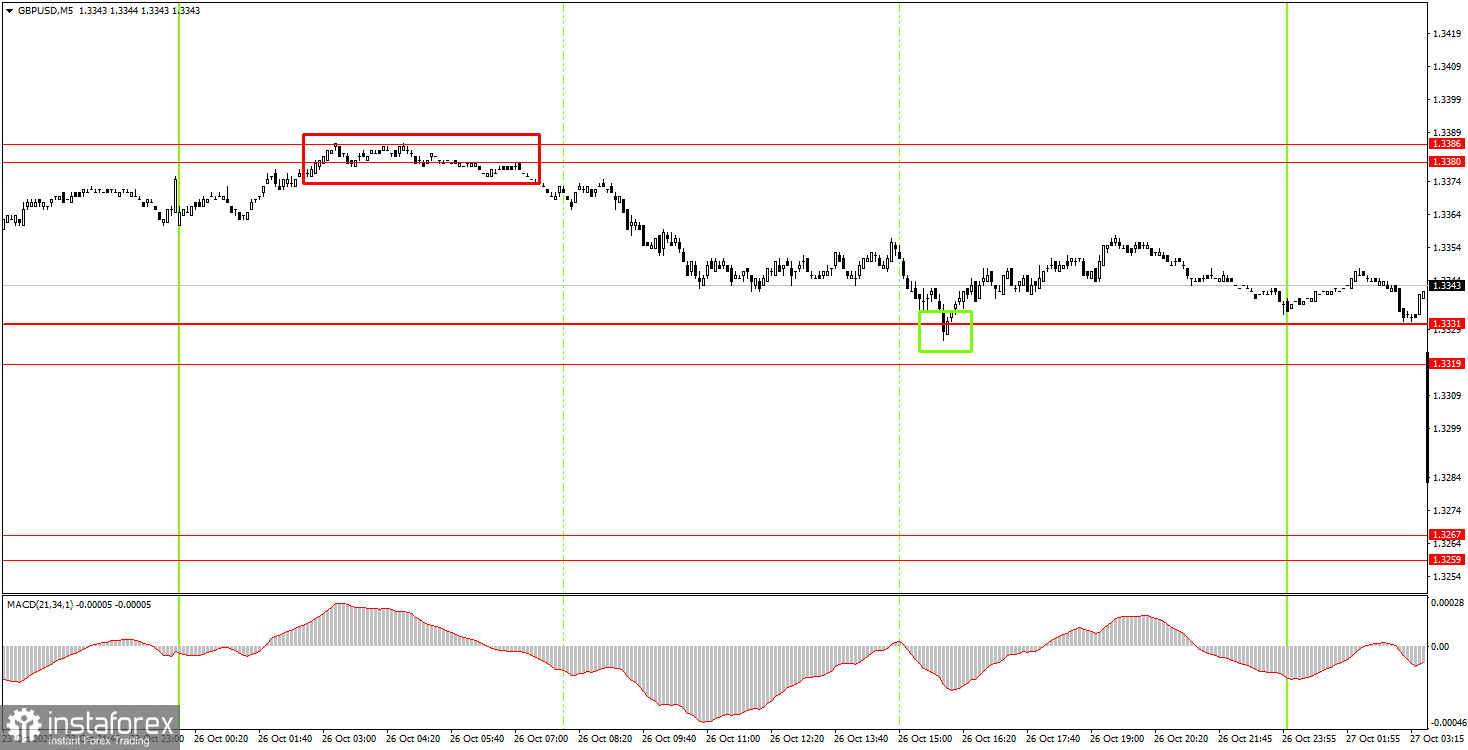
On the 5-minute timeframe, two trade signals formed on Monday. During the Asian session, price bounced off the 1.3380–1.3386 area, allowing short positions. Early in the U.S. session, the 1.3319–1.3331 area held, and price bounced off it, so shorts could have been closed for decent profit and long positions opened.
On the hourly timeframe the GBP/USD pair continues forming a new uptrend. The pound has shown greater resilience versus the dollar and therefore has better chances for an upward trend than the euro. The technical picture on most charts supports sterling's rise. The fundamental and macro backdrop, together with an overbought dollar, also supports GBP/USD.
On Tuesday, novice traders can open new shorts with targets of 1.3259–1.3267 if the price breaks below the 1.3319–1.3331 area. Consider long positions with targets of 1.3380–1.3386 if price bounces from the 1.3319–1.3331 area.
On the 5-minute TF consider trading the levels 1.3043, 1.3096–1.3107, 1.3175–1.3180, 1.3259–1.3267, 1.3319–1.3331, 1.3380–1.3386, 1.3456–1.3476, 1.3587–1.3598, 1.3631–1.3641. No important UK releases are scheduled on Tuesday. In the U.S., durable-goods orders and several minor releases are due; the market may react, but it is largely waiting for bigger events.
Price levels (areas) of support and resistance serve as targets for opening buy or sell trades or as sources of signals.
Red lines indicate channels or trend lines that show the current trend and the preferred trading direction.
The MACD indicator (14,22,3) — the histogram and signal line — is an auxiliary indicator that can also provide signals.
Important speeches and reports (listed in the news calendar) can significantly influence currency pair movements. Therefore, during their release, traders should approach trading with utmost caution, or exit the market to avoid sudden reversals against the preceding move.
Beginner forex traders should remember that not every trade can be profitable. Developing a clear strategy and practicing money management are key to long-term success in trading.


