
See also


 27.10.2026 01:47 PM
The euro continued to decline today, and even steady eurozone data failed to halt the move. By midday, the pair had fallen to around 1.1136, from which it staged a modest rebound. It is now trading near 1.1148. This marks the second consecutive weak day for the single currency, and the reason lies less in Europe itself than in the US dollar. Traders are increasingly positioning for a stronger dollar ahead of the Federal Reserve meeting.
The morning's European data were broadly in line with expectations. Private sector lending rose by 3.1% in September, exactly matching both analysts' forecasts and the previous month's figure. This indicator shows how willing businesses and households are to borrow. Since lending continues to grow despite higher borrowing costs, demand for credit remains firm, and such conditions generally support the euro. The M3 money supply, which measures the overall amount of money in the economy, came in at 3.5%, slightly below the forecast of 3.6%. This was a minor disappointment. However, the market paid little attention to these figures, as the focus had already shifted to central banks.
The Fed will meet tomorrow. The probability of a rate hike is below 10%, so a pause is expected, making the tone of the policymakers' statements the main focus. The ECB meeting follows on October 29, with most economists also expecting no change. The market expects the final increase in the deposit rate, to 2.75%, to take place in December. Christine Lagarde previously said that inflation was unlikely to move significantly closer to the target before the first half of 2027 because of developments in the Middle East. Inflation stood at 3.8% in September. High energy prices are keeping inflation elevated while putting pressure on businesses, leaving the euro with few reasons to rebound. As long as the market remains focused on the dollar, the euro is likely to stay under pressure. Only unexpectedly dovish remarks from Fed Chair Kevin Warsh could change the current picture.
The US economic calendar will finally pick up today, and the data could determine whether the dollar continues to weigh on the euro. First, September durable goods orders will be released. These are orders for equipment and goods designed to last more than three years, and they indicate whether businesses are willing to invest in expansion. Orders are expected to rise by 0.6% after declining by 0.1%. Excluding transportation, they are also forecast to increase by 0.6%, following a previous gain of 0.2%. Next comes the Conference Board Consumer Confidence Index for October. This survey of approximately 5,000 households measures how consumers assess their income prospects and the labor market. The forecast is 80.5, down from 81.9 previously, while the August reading was 89.4, indicating that the trend is already weak.
September new home sales will follow, with 649,000 expected after 684,000 previously. This indicator is sensitive to mortgage rates and shows how high borrowing costs are affecting the housing market. The final release will be the Richmond Fed Manufacturing Index for October, forecast at 1 after a reading of -2. This survey measures sentiment among manufacturers in the region. Strong data would boost confidence in the dollar and increase pressure on the euro, while weak consumer confidence and housing figures could give the pair a brief respite. Consumer confidence and housing data are likely to attract the most attention, while the remaining releases may have a more limited impact.
Momentum
The euro is currently trading at 1.1148, between two breakout levels. The upper level at 1.1155 is just seven points away, while the lower level at 1.1136 is twelve points away. The 1.1155 level is acting as resistance, and a breakout followed by consolidation above it could push the euro toward 1.1176 and 1.1195. This would require weak US data. Without such a catalyst, a move higher appears unlikely, as the overall direction of the market today is downward.
The 1.1136 level provides support. The pair has already tested this area today and rebounded. A breakout below it, followed by consolidation beneath the level, would open the way toward 1.1117 and then 1.1082. The second target is relatively distant, more than 50 points from the entry point, so it should be viewed as a potential extension of a strong decline. This remains the primary scenario. However, beginners should remember that the pair has already rebounded from 1.1136, and a second test does not guarantee a breakout. The price must first establish itself below the level.
Mean Reversion
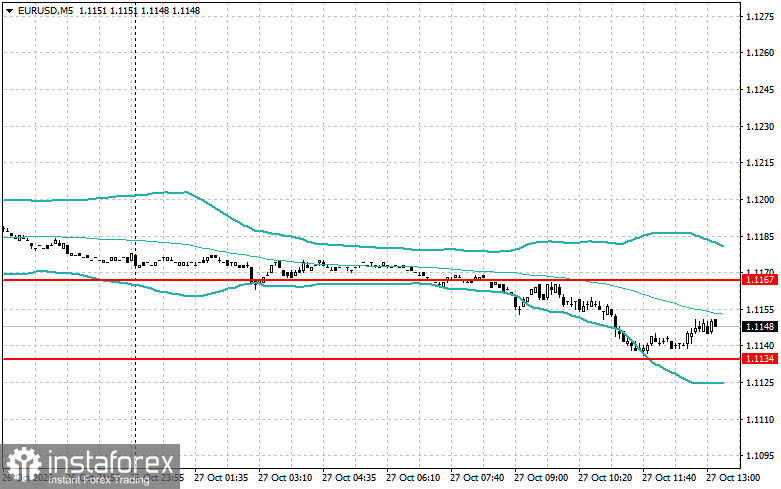
For the euro, the upper reference level is 1.1167, twelve points above the breakout level at 1.1155 and closer to the first upward target. The pair already stalled around this area in the morning. If it rises there again, fails to hold above the level, and turns lower, selling opportunities may emerge. A stop-loss should be placed above the highest point reached during the failed attempt. There is little risk of confusing the two scenarios here because the breakout level is some distance away, but one point is worth remembering. If the price moves above 1.1155, reaches 1.1167, and consolidates above it, that would indicate a continuation of the breakout, and selling at that point would no longer be appropriate.
The lower reference level at 1.1134 lies just below the breakout level at 1.1136, a difference of only two points. This requires particular caution from beginners. A two-point difference is ordinary market noise, making it difficult to determine from the first test whether the price is breaking through the level or reversing back above it. If the price moves below 1.1136, briefly declines beneath 1.1134, and quickly returns above 1.1136, this would indicate a failed breakout and a reversal. In that case, buying opportunities could be considered, with a stop-loss below the low of the failed move. If, however, the price falls below 1.1134 and holds there firmly, this would confirm a breakout, and buying would be inappropriate. The pair's daily low has almost exactly coincided with 1.1136, meaning buyers have already tested this area. However, the overall outlook for the euro remains weak, so any upward rebounds are expected to be more limited than a potential continuation of the decline.


