
See also


 12.11.2026 09:04 AM
Today oil fell to a two-month low, with Brent trading around $91 per barrel after a 1.4% rise on Wednesday and WTI near $85. Still, Brent is up more than 50% year to date. Recall Brent peaked near $116 on October 30, was $94.62 on November 4, nearly $100 on November 6, and around $97 on November 9 — so since the October high, oil has lost more than a fifth of its value.

The main reason is a recovery of flows from the Middle East. Saudi Arabia told OPEC its October production rose 26%, to one of the highest monthly levels in recent years, and Iraq reported a new wartime production record. At the end of October, Gulf deliveries were about 80% of prewar levels; now they have approached the prior norm. Rising output is already visible in the physical market: price differentials are weakening, and with limited demand the first signs of a surplus are appearing.
But the recovery relies on workarounds rather than secure sea routes. Saudi Arabia is routing part of its crude via the East-West pipeline to the Red Sea to bypass the Strait of Hormuz, and ship-to-ship transshipments are being used. Note that this pipeline was attacked near Medina on November 9, and Iranian strikes on tankers continue. Many experts therefore believe the market will retain a geopolitical premium while the parties remain far from an agreement.
Progress in talks is limited, even though the conflict has cooled somewhat. Iran will not remove "a single enriched nuclear material" from the country, Mohsen Rezaei, secretary of the Supreme National Security Council, told Al Mayadeen — and that is one of the US's key conditions for talks. Washington and Tehran also differ on frozen assets and the US maritime blockade. Traders hope a Democratic victory in the midterms will bring the end of the conflict closer. On November 9, Donald Trump said no new strikes were needed, while Marco Rubio called Iran's terms unacceptable — the tone softened, but positions remain far apart.
The diesel market is moving in the opposite direction. Ukrainian drones have again struck Russian refineries; Energy Aspects reports at least seven facilities were hit since late October, ending a brief pause in attacks and worsening the global diesel shortage. Recall US distillate inventories fell below 100 million barrels for the first time since 2003, and the EIA forecasts retail diesel at $5.03 per gallon. Official US inventory data are due this evening, and the IEA report follows on Friday.
All this means crude and refined products are diverging. I expect Brent to test $90 in the coming days, and without a deal with Iran, the downside floor will likely be near $85, while diesel will fall more slowly than crude. Upside can return on a breakdown in talks, new strikes on infrastructure, or attacks on tankers; sustained declines require confirmed reopening of Hormuz and rising inventories.
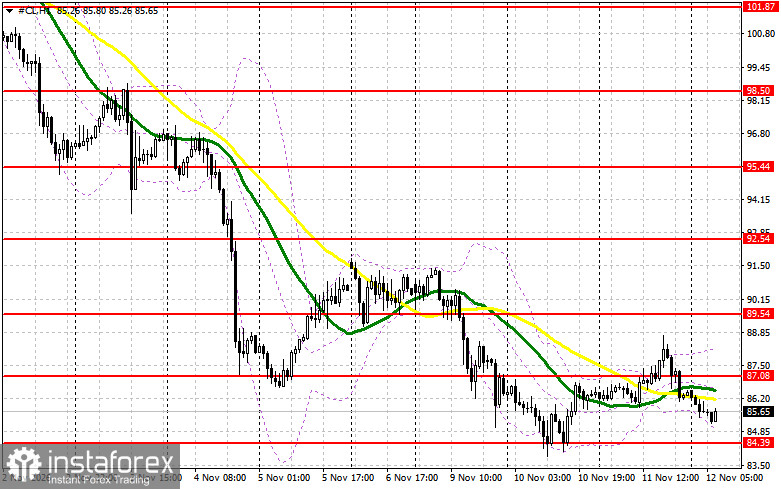
On the technical side, buyers need to take the nearest resistance at $87. That would allow targeting $89, above which a breakout will be difficult. The most distant target is $92. On a drop, bears will try to seize $84; if they succeed, a range breakout would hit bulls hard and push oil to an $81 low with the prospect of moving to $78.


