
See also


 13.11.2026 08:50 AM
Today, oil holds yesterday's gain. Brent trades just under $96/bbl after a 3.3% rise on Thursday, and WTI sits around $88. Still, Brent is headed for a second weekly decline in a row: on October 30 the contract hit a six-month high of $116.06, and year-to-date crude remains nearly 60% higher.

Support came from Trump's comments. The president told Vice President J.D. Vance to focus on domestic matters rather than negotiations with Tehran, cooling hopes for back-channel talks. "We do not need a deal with Iran," Donald Trump wrote, adding that Washington has already obtained Iran's money — hundreds of billions — and controls the strait.
Rhetoric has shifted noticeably. On November 4, Trump said there were no immediate plans for strikes; on November 8, he called new strikes highly unlikely; on November 9, he said they were not needed; and on November 6, he reportedly discussed a deal with advisers that would involve significant concessions to Iran. That option now appears sidelined. On October 29 Vance sent a letter to Mohsen Rezaei, secretary of Iran's Supreme National Security Council, though Trump then framed it as a medical-aid offer. Tehran stated on November 12 it will not remove "a single gram of enriched nuclear material" from the country — one of the US's key demands.
Downside pressure persists. Brent has retreated from the October peak as Gulf flows recover and as markets expect a Democratic victory in the midterms — which could speed a resolution of the nine-month conflict. Saudi Arabia told OPEC its October output rose 26%, to one of the highest monthly levels in years, and Gulf exports are approaching prewar norms. US Department of Energy data added to the weakness: US crude stocks rose by 4.66 million barrels for the week versus an expected 0.6 million-barrel draw; refined-product inventories also increased; and refinery utilization hit a seasonal high.
Risks, however, remain. In October, 36 confirmed attacks on commercial vessels in the Persian Gulf, Strait of Hormuz, and Gulf of Oman occurred — more than in any month since the war began. Ukraine continues strikes on Russian refineries — at least seven attacks since late October — threatening to cut global fuel supplies. A firmer US tone gives the market reason to reprice some geopolitical premium.
All this means oil remains a two-sided market. While Washington rejects negotiations and attacks on ships continue, I expect Brent to stay in a $90–98 range, biased toward the upper bound; a move above $100 would likely require fresh escalation in the Hormuz area. I expect the weekly decline to persist because physical-market excesses and rising US inventories cap the rally.
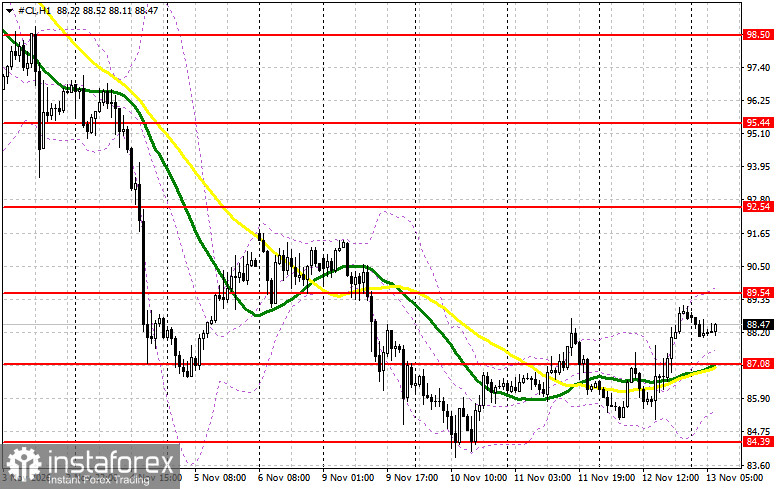
On the technical side, buyers need to take the nearest resistance at $89. That would set up a target of $92, above which a breakout will be difficult. The farther target is $95. On a decline, bears will try to seize $89; if they succeed, a range breakout would hit bulls hard and push oil to an $84 low, with a prospect of extending to $81.


