
Veja também


 07.10.2026 06:50 PM
The wave structure of the 4-hour EUR/USD chart is becoming more complex. There is still no question of invalidating the upward section of the trend (lower chart), which began in January last year. On the contrary, we have seen a complete A-B-C corrective structure, which may be complete. However, recent developments related to the Fed and its policy have once again affected the current wave structure, making it more complex. Let me remind you that the news background and wave structure often conflict with each other, making adjustments necessary.
The wave structure has now transformed into a more complex one. Wave C has taken a three-wave form, while the next wave is identified as wave D. The entire section of the trend that began on January 27 may have taken a five-wave corrective form A-B-C-D-E. If this assumption is correct, wave D is complete, and on August 21, the EUR/USD pair entered the phase of forming wave E, whose low should be below the low of wave C at 1.1325. The pair has very little distance left to this level, and below it, the presumed wave E may complete its formation at any time.
The euro barely had time to rise before falling again.
The EUR/USD pair declined by 75 points during Wednesday and appears ready to continue its overall downward move, which has been underway for a month with virtually no interruptions. Frankly, it is difficult to remember the last time I observed such a move with practically no corrective pullbacks. Market participants still do not need any news, events, or reports. They can buy the dollar even in the absence of a meaningful news background. Today was an excellent example of this. The only relatively important event has not even taken place yet, while the dollar has already gained 75 points. Let me remind you that over the previous two days, it had declined by approximately 100 points, so it has already recovered most of that decline.
What could have triggered the dollar's renewed strengthening on Wednesday? In fact, anything. As I have already said, the market does not need compelling reasons to buy the dollar. A reason can always be found. A crisis in France? Sell the euro. The Fed minutes will certainly be hawkish? Buy the dollar. The market does not take other factors into account. Since when are Fed minutes priced in ahead of time? Let me remind you that the minutes are not an inflation or labor-market report containing official forecasts that can be used to make certain assumptions. The Fed minutes generally reflect the internal stance of the FOMC, which is already well known at present, since virtually all officials of the U.S. central bank have spoken over the past two weeks. Therefore, the market is fully aware of the FOMC's stance and its future plans. So why did we see another rise in the dollar? Because of the budget crisis in France, which could develop into a political crisis?
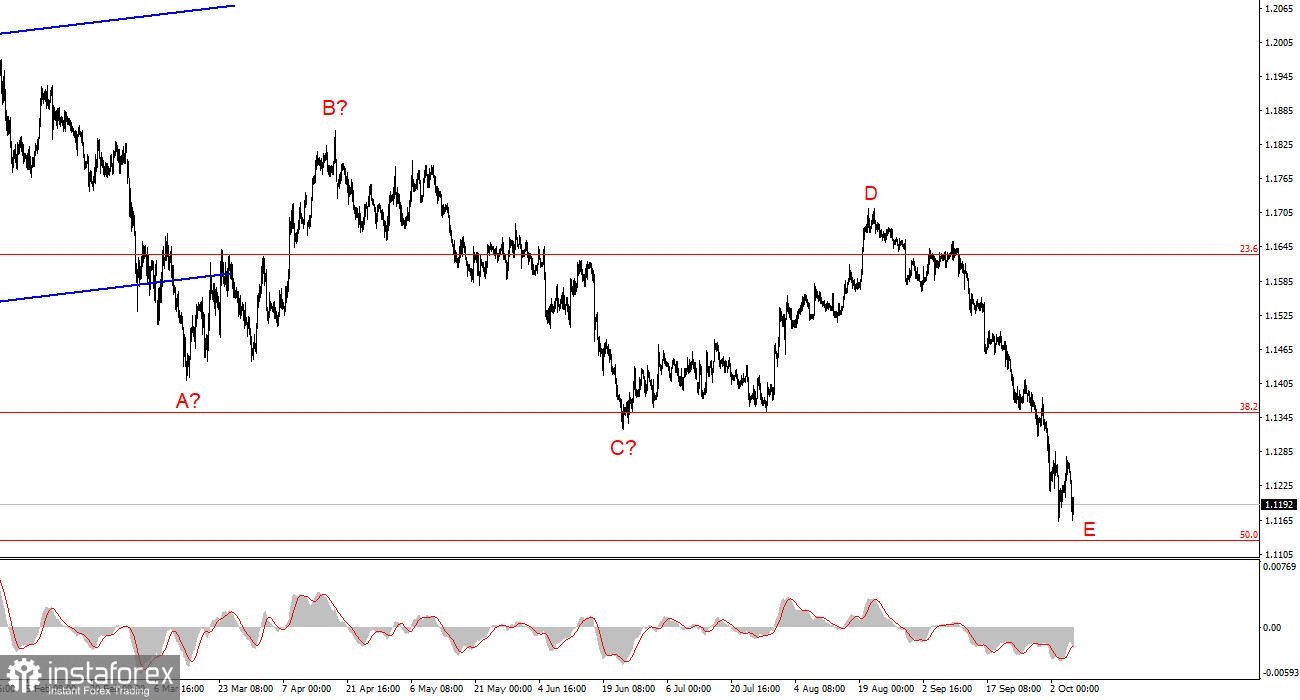
Based on my EUR/USD analysis, I conclude that the pair remains within the global A-B-C-D-E corrective section of the trend. If this assumption is correct, the decline in quotes will continue toward targets below the low of wave C at 1.1325. I considered this scenario an alternative one, and if it had not been for the Fed meeting, it would have remained a secondary scenario. However, the Fed delivered a surprise, and the market was left with no other option but to initiate another wave of buying in the U.S. currency. Yet buying has already continued for several weeks, despite the absence of new factors supporting the dollar. I would not open short positions against such a news background; on the contrary, I would prepare for a reversal.
On the higher timeframe, a downward section of the trend can be seen, taking the form of A-B-C-D-E. Therefore, the EUR/USD pair may continue to decline below the low of wave C, while the internal wave structure of wave E may take a five-wave impulsive form.
The Main Principles of My Analysis:


