
Vea también


 08.12.2025 12:54 AM
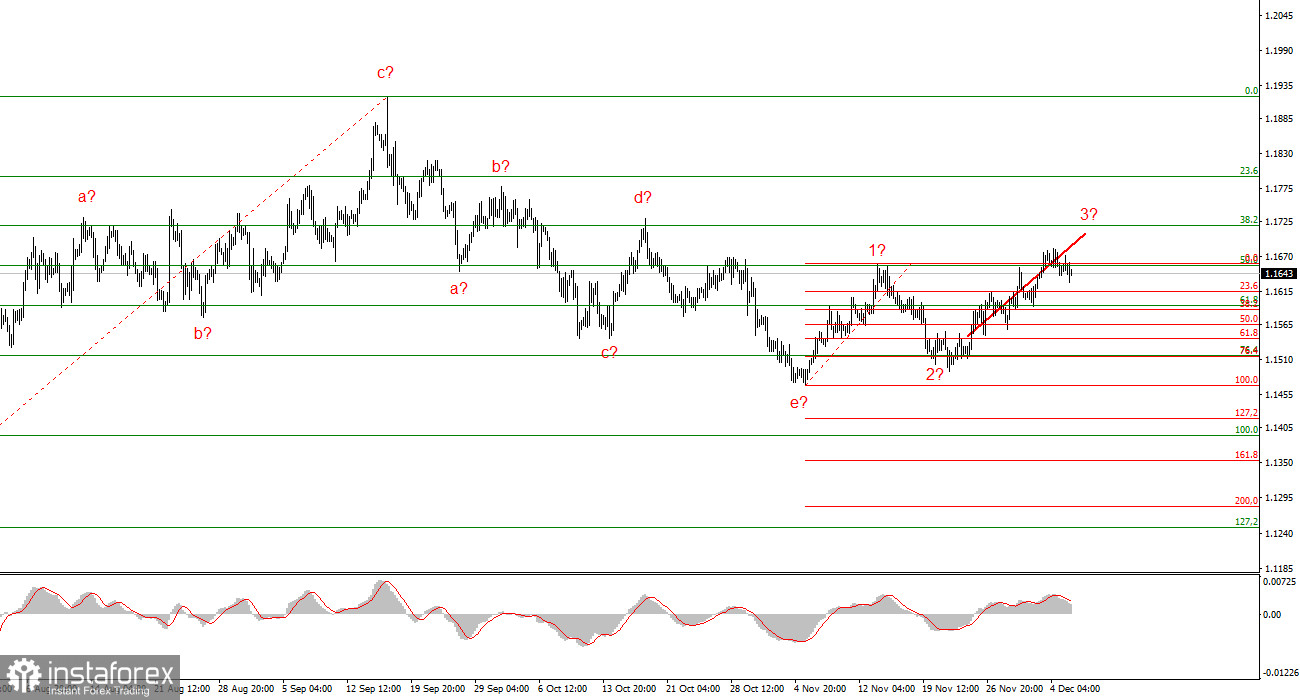
The British pound has been trading similarly to the euro in recent months (as it often does), constructing identical or very similar wave structures. However, the wave structure for the pound appears more convincing overall. We observed a long, complex corrective wave 4 that took the form of an A-B-C. Inside wave C, a corrective structure a-b-c-d-e was also formed. Following this, an upward wave set began to develop, which could signify the start of a new global wave 5 or it could simply be wave D in 4. Unfortunately, corrective structures tend to take on more complex forms and elongate.
The news backdrop for the pound in recent weeks has only created problems. The economy is growing slowly, inflation has slowed (which opens "dovish" perspectives for the Bank of England), unemployment surged to 5%, and retail trading volumes have decreased. For a long time, the British Parliament struggled to finalize the budget for the upcoming year, and the market perceived every speech by Rachel Reeves as a "red flag." Nevertheless, due to this backdrop, the GBP/USD pair formed a fairly convincing wave 4. In contrast, the euro has experienced a simple alternation of corrective structures without a distinctly three-wave form for wave 4. So, there is no bad without good.
However, the news backdrop for next week will be extremely scarce. The market continues to anticipate the FOMC and BoE meetings. Typically, "anticipation" means the market is pricing in future events. Currently, this "anticipation" denotes a wait-and-see approach.
In the UK, only two reasonably interesting reports will be released on Friday next week: GDP and industrial production for October. Interesting? Yes. Relevant? Not really. Important? Not much either. Based on this, the American news backdrop will once again take precedence, especially with the FOMC meeting set for Wednesday and the Bank of England's meeting a week later. Both central banks are likely to initiate a new round of monetary policy easing, but I will primarily focus on the wave analysis.
In my opinion, there is a high probability of beginning to build wave 5 of the global trend. In this case, the pound should remain in demand.
Based on the analysis of EUR/USD, I conclude that the instrument continues to build on the upward section of the trend. The market has paused in recent months, but Donald Trump's policies and the Fed's actions remain significant factors in the US dollar's future decline. The targets for the current trend section could extend up to the 25th figure. However, the last upward segment has once again taken on a corrective appearance; thus, a downward wave within this segment may begin, with a maximum leading to a new downward corrective set of waves.
The wave picture for GBP/USD has transformed. We continue to deal with an upward impulse section of the trend, but its internal wave structure has become complex. The downward corrective structure a-b-c-d-e in C of 4 appears quite complete. If this is indeed the case, I expect the main trend section to resume its build with initial targets around the 38 and 40 figures. However, wave 4 itself may also take on a five-wave appearance.
In the short term, I anticipated the formation of wave 3 or c with targets around 1.3280 and 1.3360, corresponding to the 76.4% and 61.8% Fibonacci levels. These targets have been achieved. Wave 3 or C may continue its build, but the current wave set is likely corrective again. Consequently, a decline at the beginning of next week is also possible, and the attempt to break the 1.3360 mark has been unsuccessful.


