Vea también


 25.02.2026 12:41 PM
Today, the EUR/USD pair once again attempted to break above the psychological level of 1.1800, recovering Monday's modest losses. The pair's intraday strengthening is linked to renewed selling of the U.S. dollar, which remains under pressure amid ongoing uncertainty regarding trade relations. After the Supreme Court ruled against sweeping tariffs, U.S. President Donald Trump announced a new tariff system, effectively confirming that his trade strategy remains unchanged. In his State of the Union address, Trump stated that under Article 122, the White House had introduced temporary global tariffs of 10% for 150 days and that the administration is seeking to raise tariffs to 15%. This has heightened concerns about potential retaliatory measures from other countries and the negative economic consequences of disruptions in global supply chains. All of this is putting pressure on the U.S. dollar and moderately supporting the EUR/USD pair.
At the same time, the overall bullish sentiment toward the dollar remains relatively resilient thanks to the hawkish rhetoric of the Federal Reserve System. Minutes from the January FOMC meeting showed that several Fed officials believe further policy easing is unjustified until there is clear evidence of a renewed disinflation process. Moreover, on Tuesday, Boston Fed President Susan Collins noted that keeping the current rate range "for some time" would be appropriate. Meanwhile, Richmond Fed President Thomas Barkin emphasized that the current monetary policy stance is well positioned to manage risks related to the economic outlook.
On the other hand, on Monday, Christine Lagarde, President of the European Central Bank, stated that inflation and monetary policy in the eurozone are currently in a comfortable position. Lagarde reaffirmed her previous guidance that no changes in monetary policy parameters are expected in the near term, providing additional support to the single currency and the EUR/USD pair. On the same day, the European Parliament decided to postpone a vote on the trade agreement between the European Union and the United States. This is restraining traders from opening aggressive bullish positions in EUR/USD, thereby limiting further upward potential.
For better trading opportunities, attention should be paid to the release of the final consumer inflation data in the eurozone. Later, during the North American session, it will be worth monitoring speeches by key FOMC officials.
Nevertheless, the mixed fundamental backdrop described above suggests refraining from aggressive directional positions.
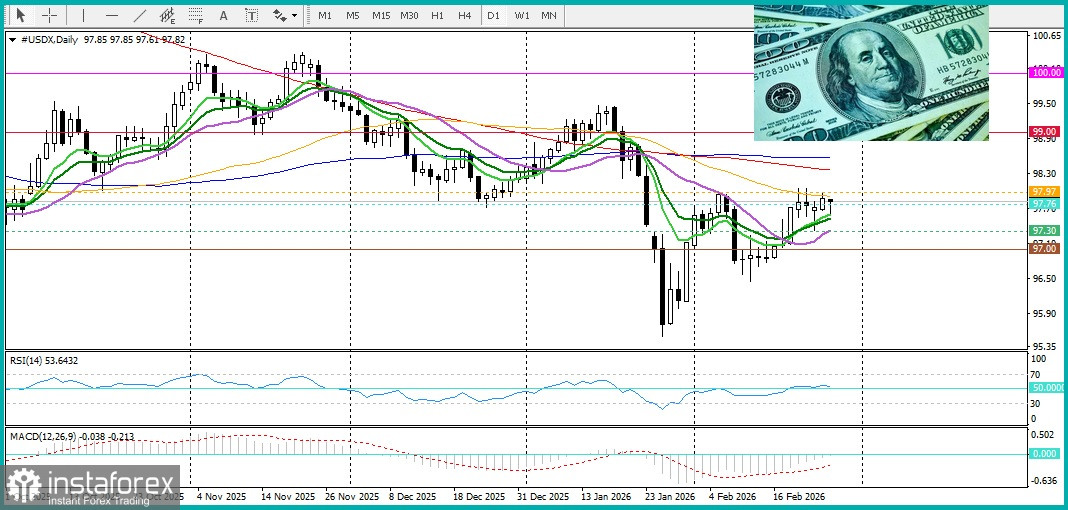
From a technical perspective, the Relative Strength Index remains in negative territory, indicating weakness among bulls. If the pair fails to hold above the 50-day SMA, the next support level will be the February low around 1.1740. A break below that could accelerate the decline toward the psychological level of 1.1700. On the upside, if prices manage to overcome the 1.1800 level and reach the 20-day SMA, bulls may regain momentum. It is also worth noting that the crucial 200-day SMA is sloping upward, indicating that the pair's primary trend remains bullish.
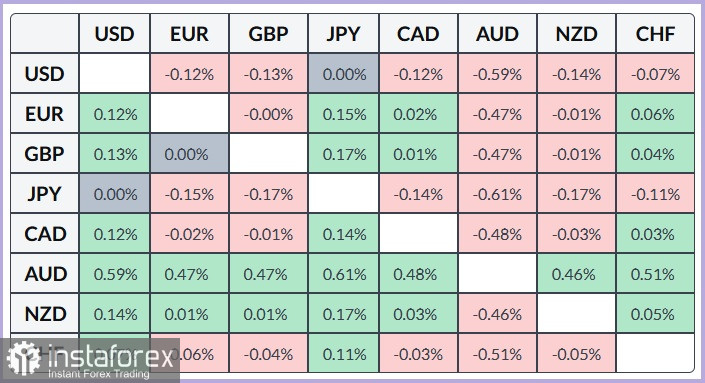
The table below shows the percentage change of the U.S. dollar against major global currencies over the day, with the strongest performance observed against the Japanese yen.