
Vea también


 02.09.2026 11:52 AM
The US dollar largely ignored weak US economic data yesterday, and there were reasons for that.
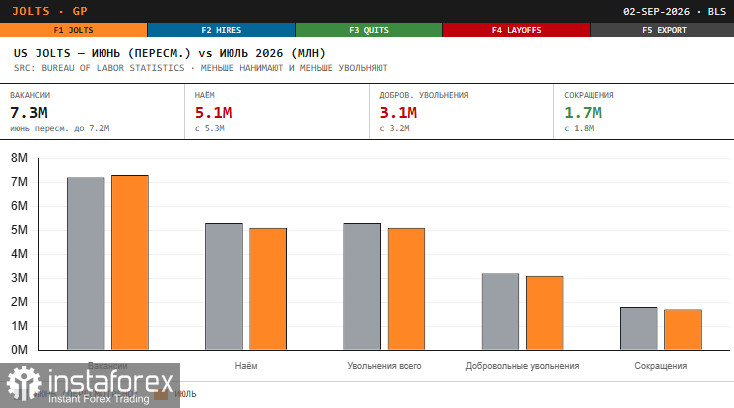
As the Institute for Supply Management report reported, the ISM manufacturing index fell to 54.6 points in August from 55.6 in July, remaining in expansion territory for the eighth month in a row, and the economy continued to expand for the 22nd consecutive month. At the same time, the JOLTS report showed that the number of job openings in July was essentially unchanged at 7.3 million, while hires and total separations each fell to 5.1 million.
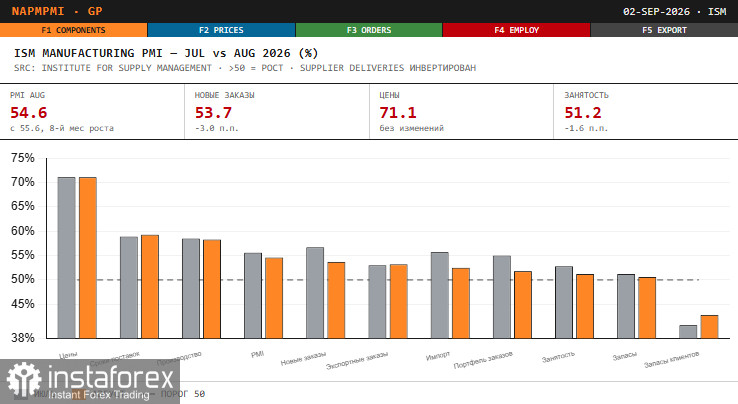
The ISM weakening affected virtually all key components. New orders dropped to 53.7 from 56.7, the backlog of orders to 51.8 from 55.0, employment to 51.2 from 52.8, and imports plunged to 52.5 from 55.7. Production fell only slightly, to 58.3 from 58.5, remaining in expansion for the tenth consecutive month. ISM Chair Susan Spencer noted that of the five subindices that make up the PMI, delivery times were the only one that accelerated, rising to 59.3, which indicates an ongoing easing of supply-chain pressures.
Notably, the price component remained unchanged. The prices index repeated July's value of 71.1, staying deeply in inflationary territory, which is bad news for the Federal Reserve. The only genuinely encouraging signal was the customer inventories index, which rose to 42.8 points from 40.7. Importantly, readings below 50 here are interpreted as inventories being "too low," which is traditionally seen as a positive indicator for future production because customers will sooner or later have to restock.
The labor market data paints a picture of frozen turnover. The report said hires fell to 5.1 million from a revised 5.3 million in June, with the main hit in professional and business services, which lost 188 thousand. Voluntary quits fell to 3.1 million from 3.2 million, and involuntary separations to 1.7 million from 1.8 million. In other words, employers are both hiring less and firing less, which fits the pattern of low hiring alongside low separations.
The dollar's reaction was noteworthy for its absence. The US currency effectively shrugged off the weakness in both reports because market attention had fully shifted to a new escalation of the conflict in the Middle East. Recall that the day before, the US struck an island in the Strait of Hormuz and Iran responded with similar attacks. Under such conditions, the dollar is supported via two channels: as a safe-haven asset during geopolitical escalation and via the inflation channel, since rising oil strengthens the case for Fed rate hikes. That is why the slowdown in hiring and the weakening of industrial orders were secondary for the currency market.
Meanwhile, the market prices roughly a 60%-chance of a September rate hike after Kevin Warsh's hawkish Jackson Hole remarks. This fork in the road will be decisive, and the unchanged ISM prices index at 71.1 points is a reminder that inflationary pressure in the manufacturing chain has not gone away.


