
Vea también


 02.09.2026 06:17 PM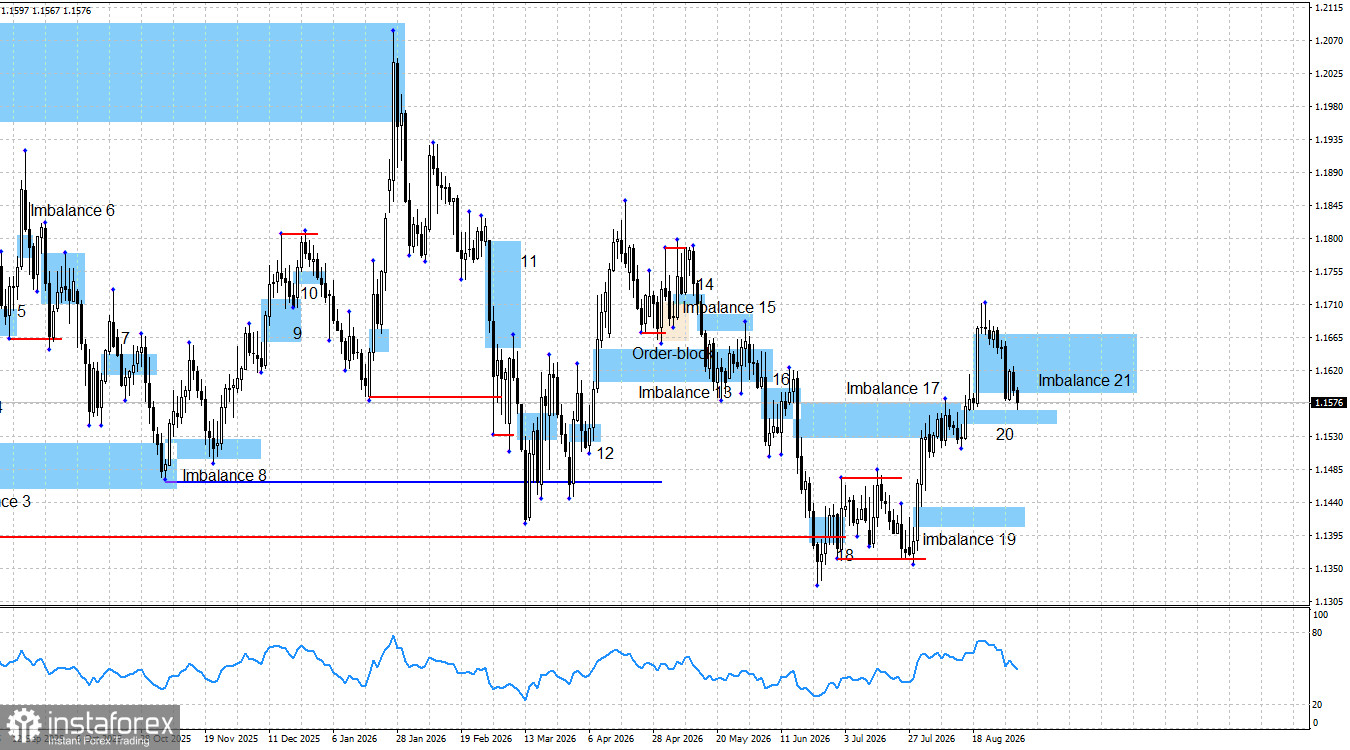
The EUR/USD pair declined for six days, but the bears' advance may end here. Overall, it can be said with confidence that the bears truly attacked only last Friday, when FOMC President Kevin Warsh first gave a speech, followed by a revision of the annual Nonfarm Payrolls data. Neither of these events was unequivocally bearish; nevertheless, they can be interpreted that way if one chooses to do so. As I wrote earlier, the Nonfarm Payrolls report could have been much worse than it ultimately was, while Warsh's speech could once again be interpreted as containing hawkish tones. However, if we assess the situation objectively, I see no reason for the dollar to rise even on Friday. The Nonfarm Payrolls report showed a negative figure, while Kevin Warsh merely spoke about high inflation but did not promise to raise interest rates or take any specific measures. The price of the European currency fell to the base of imbalance 21, and the decline has ended there for now. From here, everything will depend primarily on the U.S. labor market and unemployment data due to be released on Friday.
Overall, in my view, the fundamental backdrop continues to fully support the bulls. First, any chart clearly shows that the European currency began its rise from relatively low levels, compared with the average price over the past year. This means that it still has upward potential. Second, the market continues to doubt that the FOMC will tighten monetary policy in September, regardless of what statements Warsh makes. Third, U.S. economic data has recently been a source of disappointment. Fourth, geopolitics no longer supports the bears or the dollar. Fifth, the ECB may implement another monetary policy tightening this autumn. Sixth, the U.S. Treasury has decided to increase its purchases of long-term bonds, which reduces demand for the dollar. Seventh, a new trade war between the United States and Canada and between the United States and China could begin in the near future. Eighth, the U.S. labor market is contracting, which could put an end to Warsh's hawkish initiatives. Thus, I currently see no reason whatsoever for a bearish advance.
The latest U.S. labor market data showed weak figures, inflation showed a slowdown, and GDP showed a decline in its growth rate. These three factors make me doubt that the FOMC will raise rates not only in September but also before the end of the year. In my view, the bears' only opportunity at present lies in a new escalation in the Middle East.
The current chart picture points to the continuation of bullish momentum. The price has completely filled the latest bullish imbalance 21 and may even touch the previous bullish imbalance 20. The combined reaction to these two patterns could bring the bulls back into the market, and the upward movement will resume. If one or both patterns are invalidated, the bears will then be able to launch their own advance, but even in that case they will need fundamental support. Where could they get it?
There was virtually no economic backdrop on Wednesday. The only report worth noting, ADP in the United States, did not trigger any market reaction, as traders are once again betting on Nonfarm Payrolls, which will be released on Friday. For imbalance 20 to be invalidated, Nonfarm Payrolls would finally need to show a strong figure.
There are still a huge number of reasons for the bulls to attack in 2026, and even the outbreak of war in the Middle East has not reduced their number. Structurally and globally, Trump's policies, which led to a significant decline in the dollar last year, have not changed. At present, I see no significant factors supporting the U.S. currency, despite the FOMC's formally hawkish stance. Geopolitics, which supported demand for the U.S. currency for most of the first half of 2026, is no longer doing so. The conflict in the Middle East remains unresolved, but there have been no new hostilities from either Iran or the United States.
News calendar for the United States and the European Union:
On September 3, the economic events calendar contains four entries, among which I would highlight the ISM index. The economic backdrop may affect market sentiment in the second half of the day on Thursday.
EUR/USD Forecast and Trading Tips:
In my view, the pair remains in the process of forming a bullish trend that paused for an entire year. The fundamental backdrop shifted sharply in favor of the bears six months ago, but the trend itself cannot be considered canceled or complete. In the long term, I would say that the pair is range-bound. However, a range does not invalidate the broader trend. Thus, the bulls may well continue their advance after two liquidity sweeps of clearly defined lows. At present, bullish traders have an excellent support level in the form of imbalance 20, where a new bullish signal may form. I consider 1.1797 and 1.1850 to be the upward targets for the European currency.


