
Vea también


 28.09.2026 08:40 AM
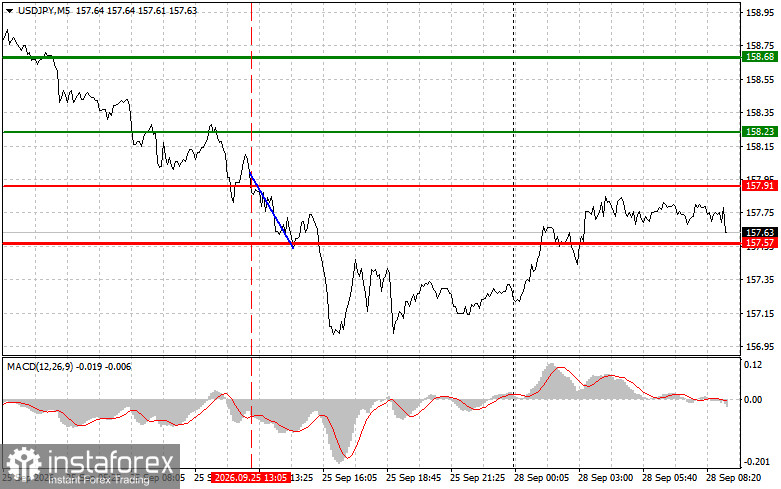
The price test at 157.91 occurred as the MACD indicator began moving down from the zero line, confirming a correct entry point to sell the dollar. As a result, the pair fell toward the 157.57 target.
Late last Friday, US data briefly restored confidence in the dollar. The University of Michigan consumer-sentiment index rose to 48.1 in September from 47.8 in August. This gauge reflects how US households assess their incomes and economic prospects, and because consumption forms the bulk of US GDP, even a small rise is read by the market as a sign of steady demand. Such data usually reduce the chances of a sharp Federal Reserve easing and support the dollar. USD/JPY received a recovery impulse, but it was short-lived, and downward pressure returned soon after.
The Japanese political backdrop now matters more for the pair than US data. Statements by Japan's prime minister late last week led the market to seriously consider that Tokyo is prepared to defend the yen. That view was reinforced by support for Japan's position from Trump. I believe the market reads this as a signal that Japan's hands are untied and that any actions to halt the currency's weakening would not face Washington's objections. As a result, traders returned to active yen buying against the dollar, and the Michigan index's strength proved only a weak counterargument amid those headlines.
It is worth recalling why traders fear intervention. When authorities see the national currency weakening too quickly, they can enter the market and sell dollars for yen, which can sharply move the exchange rate in favor of the yen within minutes. Those who bought USD/JPY expecting further gains suffer rapid losses during such episodes, which is why many prefer to cut positions when intervention talk returns to the headlines. While this threat hangs over the market, the advantage belongs to the pair's bears — those betting on declines and buying yen.
I expect this situation to persist until the market decides the intervention threat has passed. That could happen if Japanese authorities soften their rhetoric or demonstrate in practice that they do not intend to intervene. Once participants feel the protective umbrella over the yen is gone, dollar buyers will have room to maneuver, and strong US data plus the dollar's appeal could resume full effect. At that point, USD/JPY would likely resume its rise toward the 160 area, which traders view as a psychological threshold likely to trigger a Tokyo reaction. Until then, I expect cautious trading and frequent pullbacks in the pair.
For intraday strategy, I will mainly rely on Scenarios No. 1 and No. 2.
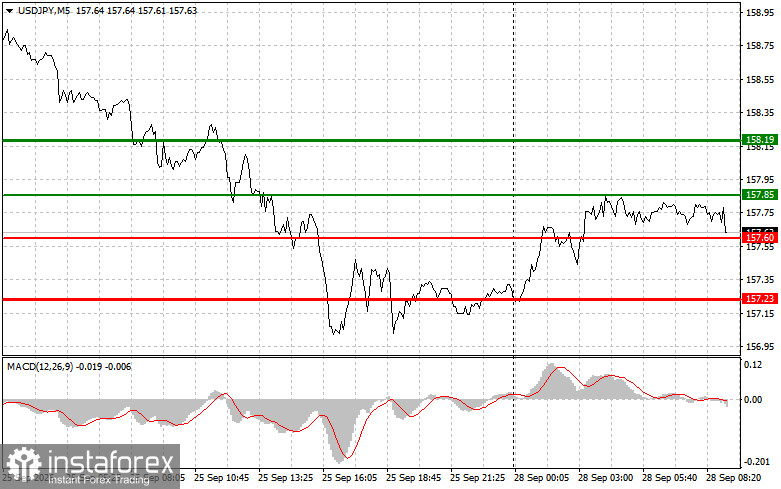
No 1: I plan to buy USD/JPY today if price reaches the entry area around 157.85 (green line on the chart) with a target of 158.19 (thicker green line on the chart). Around 158.19, I plan to exit long positions and open short positions in the opposite direction (expecting a 30–35 pip counter-move). It is best to return to buying the pair on corrections and significant pullbacks. Important: before buying, ensure the MACD indicator is above zero and has just begun rising.
No 2: I also plan to buy USD/JPY if the price tests 157.60 twice in a row while the MACD is in the oversold area. This would limit the pair's downside potential and lead to an upward reversal. Expect moves to 157.85 and 158.19.
No 1: I plan to sell USD/JPY today only after the 157.60 level is breached (red line on the chart), which should lead to a rapid decline. The sellers' key target will be 157.23, where I plan to exit shorts and immediately open longs in the opposite direction (expecting a 20–25 pip counter-move). Sellers can return at any moment—it only takes a hint from the central bank. Important: before selling, ensure the MACD indicator is below zero and has just begun falling.
No 2: I also plan to sell USD/JPY if the price tests 157.85 twice in a row while the MACD is in the overbought area. This would limit upside potential and trigger a downward reversal. Expect falls toward 157.60 and 157.23.
Important: Beginner traders in the Forex market need to be very cautious when making entry decisions. It is best to stay out of the market ahead of significant fundamental reports to avoid being caught in sharp price fluctuations. If you decide to trade during news releases, always set stop orders to minimize losses. Without stop orders, you can quickly lose your entire deposit, especially if you do not employ money management practices and trade large volumes.
Also, remember that successful trading requires a clear trading plan, similar to the one provided above. Making spontaneous trading decisions based on current market conditions is inherently a losing strategy for intraday traders.


