
Vea también


 29.10.2026 08:27 AM
Last night, the euro briefly found unexpected support from the Federal Reserve but couldn't hold it. After the U.S. central bank's decision, the pair shot up to about 1.1170, then slid back to roughly 1.1141 by Thursday morning. The dollar lost its footing for a while because the market had expected stronger language from the Fed but heard more cautious phrasing instead. The euro, however, had no independent reason to rally, so the whole gain evaporated overnight.
No euro-area data came out this morning, so the key releases were from the U.S. The Fed kept the policy rate in the 3.75%–4.00% range; votes were split — ten members voted to pause while two, Lisa Cook and Beth Hammack, voted for an immediate 25-bp hike. That divergence sounds notable, but the market had hoped for clearer guidance from Fed chair Kevin Warsh. He described the U.S. economy as strong and acknowledged Q3 GDP could exceed 3%, but he immediately noted inflation has not improved. In December, he gave no clear signal, saying he needs more data before deciding. The market wanted clarity and got uncertainty, so the dollar did not rally.
Notably, Warsh said something about oil: previously, rising energy prices pushed market rates higher, but that link has weakened now that U.S. Treasury yields have begun falling. That is an unwelcome signal for the dollar because high yields had been one of its main supports. Without that support and without hawkish rhetoric from the Fed, the dollar struggled. Yesterday's U.S. data didn't help either: the goods trade deficit widened to $134.9 billion in September from a $130.4 billion forecast (a headwind for the currency). U.S. crude inventories fell by 1.462 million barrels—a smaller draw than a week earlier and larger than the 0.3 million forecast—leaving the picture mixed and offering no clear support for the dollar.
Today attention shifts to Europe. The main event is the European Central Bank decision. The market expects a pause — the deposit rate will likely stay at 2.50% and the main rate at about 2.65%. Before the decision, only Italy's Q3 unemployment is due (forecast 6.2%), so I don't expect a strong market reaction to it. The pause is already priced in, so it won't, by itself, give the euro a reason to rally; instead, the decisive factor will be Christine Lagarde's tone at the press conference.
To understand the mood, recall the prior meeting: in September the ECB raised rates by 25 bp — its second hike since the U.S.–Iran conflict began (after June). Lagarde declined to commit to a firm path thereafter, and German two-year yields moved to 2023 highs. Most economists now expect a pause today and a final hike to 2.75% in December. ECB officials differ only in nuance: Joachim Nagel warned on October 16 that new steps cannot be ruled out if conditions do not change, while Olli Rehn emphasized a balanced approach and said staff projections will be updated in December. So all eyes at the press conference will be on tone. Only a decisively hawkish stance — for example, hints of faster or more frequent tightening — can prompt buyers of the euro. In a softer outcome, the pair will likely only move modestly, and the main directional move will come after Lagarde's remarks.
The euro is now at 1.1141, and overnight the pair traded within a range between two breakout levels. The upside reference is 1.1158. If the euro holds above it, the path opens to 1.1176 and then 1.1195. Such a move would require a hawkish tone from Lagarde, and I would wait for that scenario only for that reason. The downside reference is 1.1136, five pips below the price. A break and hold below it could push the pair to 1.1115 and 1.1082. If the ECB disappoints, that direction becomes the primary focus. Reminder for beginners: five pips is very close, and a first touch is not a confirmed breakout. On an ECB decision day, the initial reaction is especially often false, so wait to see how price behaves during the press conference.
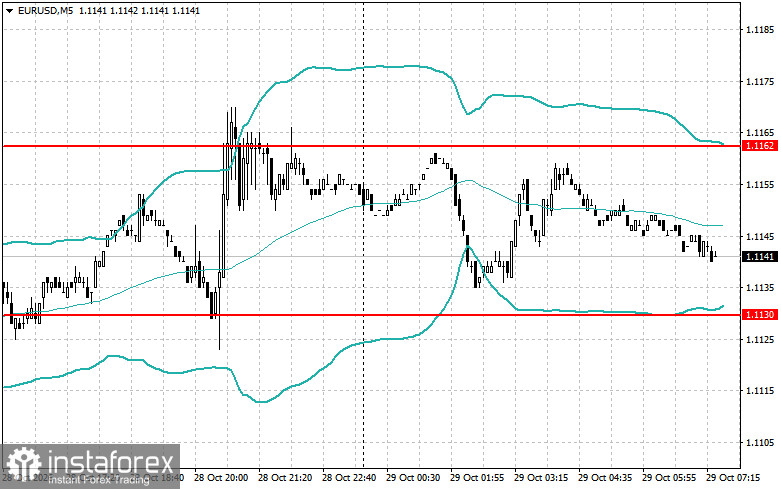
Upside reversion level: 1.1162, only four pips above the breakout point 1.1158, so extra caution is required. Four pips is market noise, and on the first touch you cannot reliably distinguish a breakout from a reversion. If price clears 1.1158, reaches 1.1162, and decisively holds above, that is a confirmed breakout and selling is off the table. If it merely spikes above, fails, and quickly returns below 1.1158, the reversion plays, and I would consider selling with a stop above the high of the failed attempt. Overnight, the pair tested this zone and then retreated, so the scenario has already been tried.
Downside reversion level: 1.1130, six pips below the breakout level 1.1136, so confusion with the breakout is smaller. Here I look for long positions if price briefly falls below 1.1130, finds no follow-through, and returns above 1.1136. Place the stop below the low of the failed attempt. But if price calmly moves below 1.1130 and holds there, the reversion fails, and the sell scenario begins. On ECB decision day, I wouldn't rush entries until the press conference, because reactions can blow through any level.


