
Vea también


 29.10.2026 08:27 AM
The U.K. budget was so calm that the pound barely reacted. Chancellor John Healey presented a plan with no major surprises or unfunded promises, and the fiscal buffer—the amount the government can miss its forecasts by without breaching its own rules—stood at about £15 billion. In March it was nearly £24 billion; the reduction reflects higher borrowing costs rather than new spending. That distinction matters to the market because this is about the price of debt, not fiscal largesse. Asset moves confirmed there were no unpleasant surprises: the 10-year gilt yield fell to 5.321%, remaining well below October's high of 5.527%, and the pound slid only about 0.1%. Traders expected a boring budget and got one.
Then came the Federal Reserve. Here the pound gained. The U.S. central bank held rates, with votes split — ten FOMC members for a pause and two for an immediate hike. Fed chair Kevin Warsh gave no clear guidance on December, saying he needs more time and data before the next move. The market had expected tougher language, so the dollar did not receive fresh support.
Today the U.K. calendar is light. Lending data are due and, while typically treated as background, they are straightforward: they show how willing British households and firms are to borrow under high rates. Mortgage approvals for September are forecast at 54.0k after 54.9k; net lending to individuals is seen at £6.2bn after £6.9bn; and the M4 money aggregate is expected at 0.3% after 0.4%. All three forecasts imply a modest cooling, but I see no surprises given the prior prints and consensus. For such data to move sterling meaningfully, they would have to deviate markedly from expectations.
I believe budget risk has faded to the background and the pair will now react to Bank of England rate expectations and the state of the U.S. dollar. The main threat to a calm scenario remains unexpectedly strong U.S. GDP prints.
The pound is now at 1.3316, and over the last 24 hours it has traded between two breakout levels. The upside reference is 1.3332, about 16 pips from the price. A break and hold above it could push the pair to 1.3361 and then 1.3390. Overnight, the pair did probe slightly above that level, rising to roughly 1.3335, but it failed to hold and fell back, so the initial touch was not a confirmed breakout. A genuine breakout would require either weak U.S. GDP or a dovish European Central Bank tone. The downside reference is 1.3303, about 13 pips below. A break and hold below that would open the way to 1.3272 and 1.3241 — the scenario that would play out if U.S. GDP prints very strong and the dollar picks up again. Given yesterday's muted Fed reaction and a calm budget, I am slightly biased toward upside, but I do not have strong conviction.
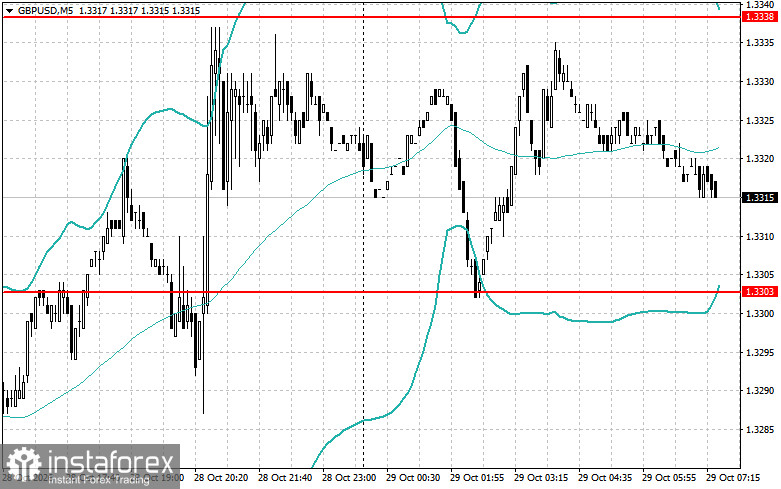
Upside reversion level: 1.3338, just six pips above the breakout point of 1.3332, so extra caution is required. Six pips is almost market noise; on the first touch, you cannot reliably distinguish a breakout from a reversion. If price clears 1.3332, reaches 1.3338, and decisively holds above, that is a confirmed breakout and selling is off the table. If it merely spikes above, fails, and quickly returns below 1.3332, the reversion plays, and I would consider selling with a stop above the high of the failed attempt. The overnight attempt to 1.3335 looks like such a failure, though it did not quite reach the 1.3338 anchor.
The downside reversion level at 1.3303 coincides with the breakout-sell level, and the picture is most ambiguous here. The same price can yield two opposite scenarios. If the pair moves below 1.3303 and holds there, that is a downside breakout, and buying is off the table. If it briefly dips below, finds no follow-through and returns above, the reversion works, and I would consider long positions with a stop under the low of the failed attempt. Overnight, the price stalled right in this zone and then moved up — exactly how a successful reversion looks. You can only tell which scenario is playing out by watching price behavior after the touch, so I would skip the first reaction in this zone and wait for clarity. Exercise particular caution around the ECB decision and the U.S. GDP release, since price can spike through any level in those moments.


