
Vea también


 29.10.2026 08:46 AM
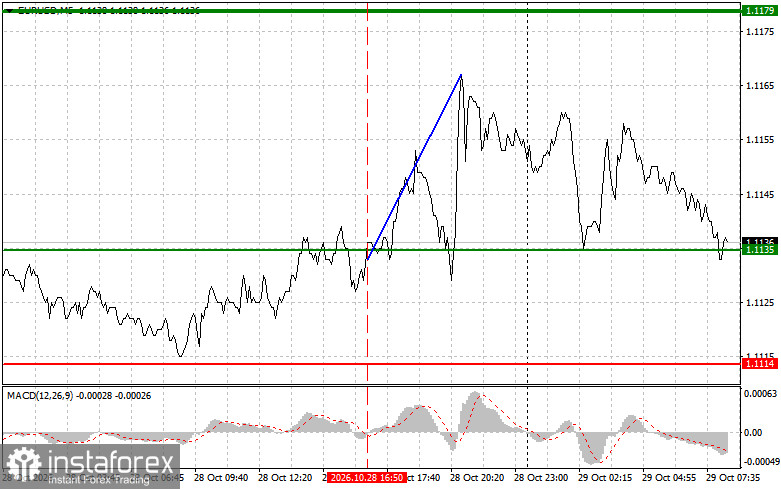
The test of the 1.1135 level occurred as the MACD indicator began moving up from the zero line, confirming a valid entry point to buy the euro. As a result, the pair rose about 30 pips.
After the Federal Reserve meeting, the market is trying to understand what exactly was decided, and so far the conclusions are cautious. The rate was left in the 3.75%–4.00% range; two members, Lisa Cook and Beth Hammack, voted for an immediate 25-bp hike while ten voted to pause. That outcome could have been a strong argument for the dollar, but Kevin Warsh's remarks at the press conference noticeably softened it. The chair said the U.S. economy remains strong and Q3 GDP will likely exceed forecasts. He was far more cautious on inflation and acknowledged the picture has not improved. The most important thing for the market was what Warsh did not say: there was no clear answer on December. He said he needs more time and data before the next decision and did not predict the next move.
Today the market faces pressure not only from the Fed's muted support. In the first half of the day, the European Central Bank will announce its decision, and the central bank is expected to hold the deposit rate at 2.50%. Lagarde has previously said energy prices will keep inflation above target into the first half of 2027, so ECB rhetoric is unlikely to soften. Governing-Council views are mixed. Isabel Schnabel argued that at current rates inflation is unlikely to return to target in the medium term. Philip Lane says 2.5% is the upper boundary of neutral and describes the response as balanced without need for abrupt moves. Piero Cipollone warned against overtightening. Olli Rehn and Martins Kazaks urge patience and waiting for new data toward December, while Joachim Nagel allows for further steps if conditions do not improve. So the decision is effectively deferred to December, when forecasts will be published. I believe that if the ECB's tone is neutral, the pair will look to U.S. data for direction.
For intraday strategy, I will mainly rely on Scenarios No. 1 and No. 2.
Scenario No. 1: Today, it is possible to buy the euro around 1.1147 (green line on the chart), targeting a rise to 1.1179. At 1.1179, I plan to exit the market and also sell the euro in the opposite direction, expecting a 30–35-pip move from the entry point. You can count on the euro rising today only if the ECB adopts a hawkish tone. Important! Before buying, make sure the MACD indicator is above zero and is just beginning to rise from it.
Scenario No. 2: I also intend to buy the euro today in the event of two consecutive tests of 1.1127 when the MACD indicator is in the oversold area. This will limit the pair's downside potential and lead to an upward reversal. One can expect a rise to the opposite levels of 1.1147 and 1.1179.
Scenario No. 1: I plan to sell the euro after it reaches the 1.1127 level (red line on the chart). The target is 1.1097, where I plan to exit the market and immediately buy in the opposite direction (expecting a 20–25-pip move from that level). Pressure on the pair will return if data is weak. Important! Before selling, make sure the MACD indicator is below zero and is just beginning to decline from it.
Scenario No. 2: I also intend to sell the euro today in the event of two consecutive tests of 1.1147 when the MACD indicator is in the overbought area. This will limit the pair's upside potential and lead to a downward reversal. One can expect a decline to the opposite levels of 1.1127 and 1.1097.
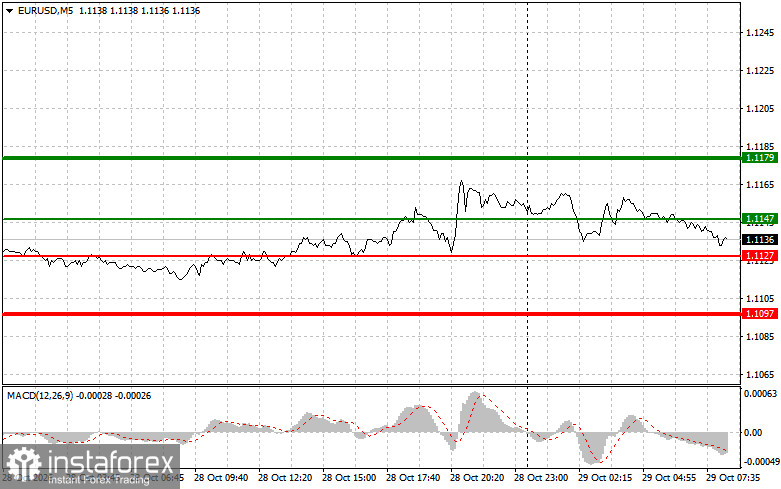
Thin green line — entry price where you can buy the instrument.
Thick green line — approximate price where you can place Take Profit or manually lock in profits, because further upside above this level is unlikely.
Thin red line — entry price where you can sell the instrument.
Thick red line — approximate price where you can place Take Profit or manually lock in profits, because further downside below this level is unlikely.
MACD indicator. When entering the market, it's important to consider overbought and oversold zones.
Important. Novice Forex traders must be very cautious when deciding to enter the market. It is best to stay out before major fundamental reports to avoid getting caught in sharp price swings. If you decide to trade during news releases, always place stop orders to minimize losses. Without stop orders, you can quickly lose your entire deposit, especially if you don't use money management and trade large volumes.
Remember: successful trading requires a clear trading plan, like the example above. Spontaneous trade decisions based solely on the immediate market situation are, by definition, a losing strategy for an intraday trader.


