
Vea también


 06.11.2026 08:13 PM
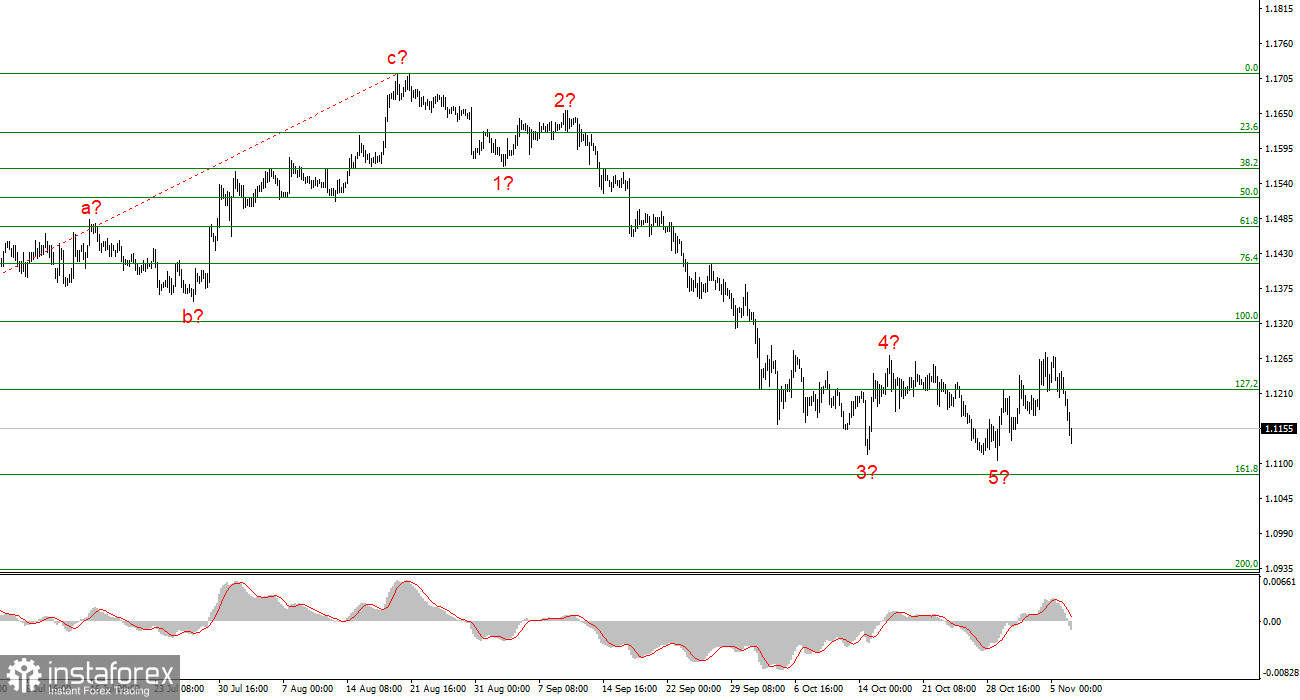
The wave count on the 4-hour chart for EUR/USD has become more complex. On the higher timeframe (bottom chart), the downward trend segment has taken the form of a five-wave structure, A-B-C-D-E, which could be complete at any moment, as it appears to be fully developed. All the waves within this segment are approximately equal in size, so this structure is considered corrective. If this assumption is correct, a new upward impulse segment will begin once it is complete, with targets located well above the 20.00 level.
On the lower timeframe (top chart), the development of an impulsive wave sequence continues, which may belong to wave E of the higher timeframe. If this is indeed the case, the dollar's strengthening is nearing its end, regardless of how much further it rises. The presumed wave 5 of E is either complete or close to completion. In any case, the current wave structure suggests that the downward wave sequence is nearing completion on both charts. The news background and the sharp shift in market sentiment have led to a strong rally in the US dollar, but few new factors remain to support further dollar strength.
The EUR/USD pair declined by 65 basis points on Friday, once again casting doubt on the current wave count, which has indicated a transition to an upward wave sequence for several consecutive weeks. Whenever the euro receives reasonably convincing reasons to rise, either buyers act too cautiously, the market ignores the news background, or subsequent information completely offsets all the positive factors supporting the euro. The same thing happened this week. The European currency could have posted a much more substantial gain following the US Congressional elections. Demand for the euro could also have been considerably stronger following the release of the Eurozone inflation report. However, the euro rose for several days before collapsing within just a few hours.
At present, there is insufficient evidence to conclude that the current wave count has been invalidated and that the instrument will definitely resume its decline and extend the downward wave sequence. However, every new decline in the euro brings traders closer to precisely this scenario. The European currency may still avoid breaking below its previous two lows, but this would require the news background to remain firmly supportive of the euro over the next few weeks and market participants to stop focusing exclusively on negative developments in the European Union. If these conditions are met, the development of an upward trend segment will begin.
However, if Donald Trump resumes military action in the Middle East in the near future, geopolitical factors will once again come to the forefront. Geopolitical developments are unlikely to trigger a substantial appreciation of the US dollar again, as the resumption of a conflict that had been put on hold would no longer come as a surprise, while the dollar has already been rising for more than two consecutive months. Nevertheless, Trump could opt for a more aggressive escalation in an attempt to force Iran to capitulate. The more intense and widespread the escalation, the higher the probability of another flight of capital into the safe-haven US dollar.
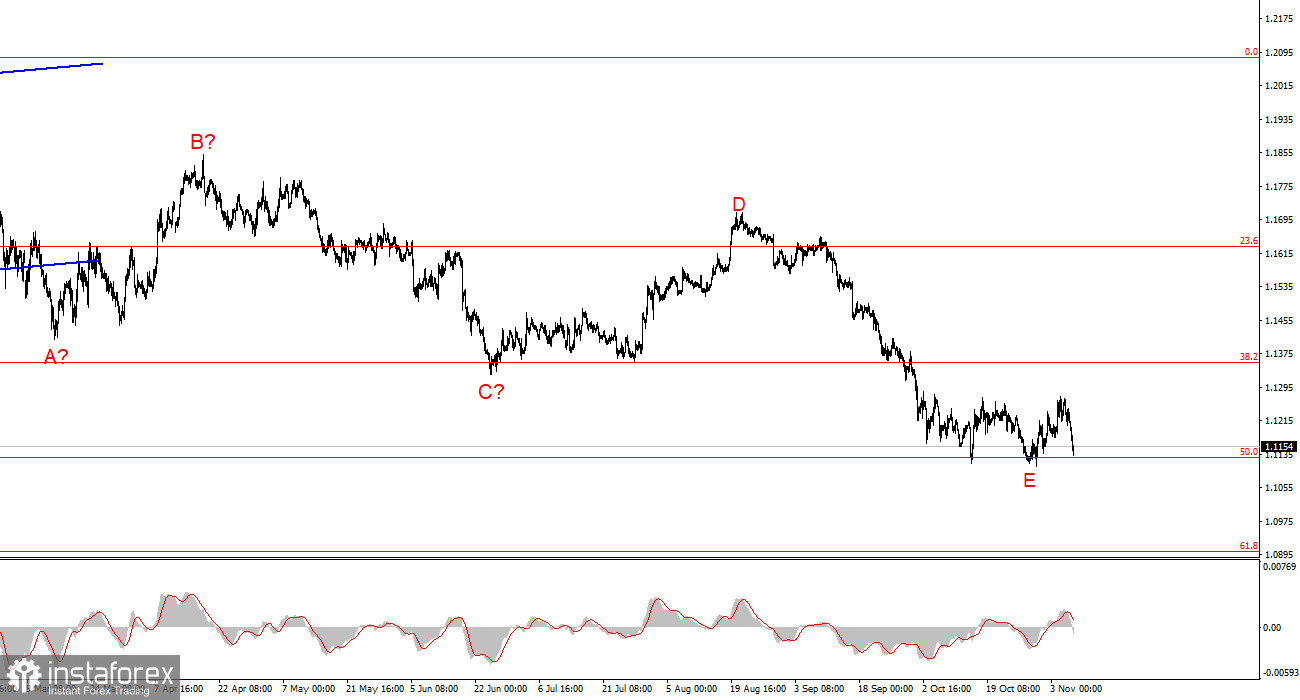
Based on the EUR/USD analysis, the pair remains within the framework of a global corrective trend segment A-B-C-D-E. However, this structure appears to be fully developed and may therefore be complete. The current conditions appear favorable not only for buying the European currency but also for anticipating the development of a full-fledged upward trend segment. According to the higher timeframe, the pair is expected to rise by at least to the 17.00–18.00 levels. The failed attempt to break above 1.1126, corresponding to the 50.0% Fibonacci level (bottom chart, higher timeframe), also indicates that the market may be preparing for a move higher.
On the higher timeframe, the downward trend segment is clearly visible and has taken the form of an A-B-C-D-E structure. The internal wave structure of wave E has developed into a five-wave impulse pattern, which may already be complete. If this assumption is correct, the development of a new upward trend segment will begin.
The main principles of my analysis:
1. Wave structures should be simple and easy to understand. Complex structures are difficult to trade and often involve changes in the market outlook.
2. If there is uncertainty about current market conditions, it is better to stay out of the market.
3. There can never be 100% certainty about the direction of price movement. Always use protective Stop Loss orders.
4. Wave analysis can be combined with other types of analysis and trading strategies.


