
Vea también


 24.11.2026 04:03 AM
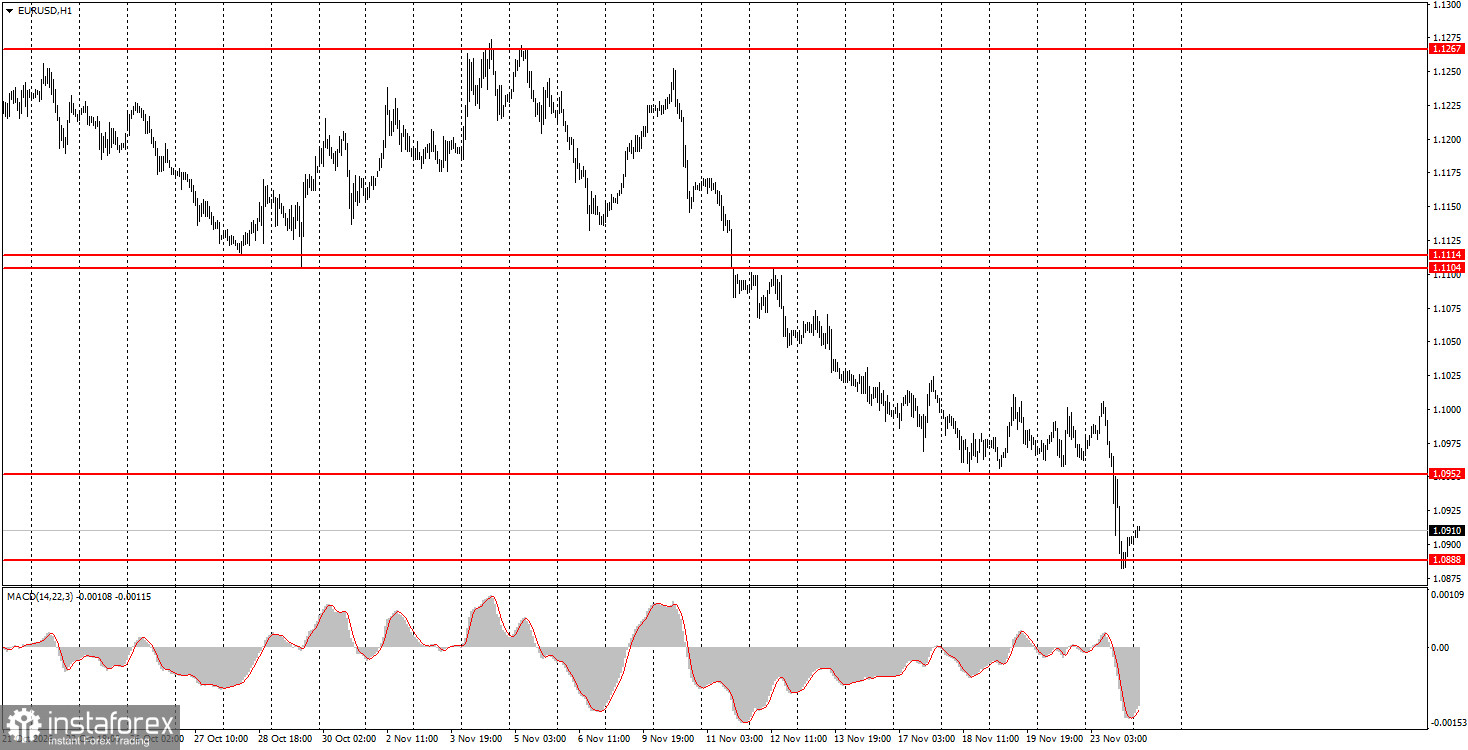
On Monday, the EUR/USD pair suffered another collapse. The day unfolded in the pattern traders have grown accustomed to over the past three months. First, the pair traded flat for several days, then plunged for no apparent reason. That is how the euro has behaved in recent months. There were no fundamental reasons for a new euro decline and dollar rise. We have been saying this for three months: EUR/USD is in a free fall, and the market is ignoring macroeconomic, fundamental, and geopolitical factors. Of course, people can point to "rising hawkish Fed expectations," but after three months of relentless dollar strength, does anyone consider the move logical? Has there not been a single report or event in favor of the euro during these three months? We continue to view the market move as purely speculative and illogical. In short, there is no meaningful connection between news flow and market action. Yesterday the eurozone and German PMIs for November were published, and three of the four indices beat expectations. Both U.S. PMIs came in below forecasts...
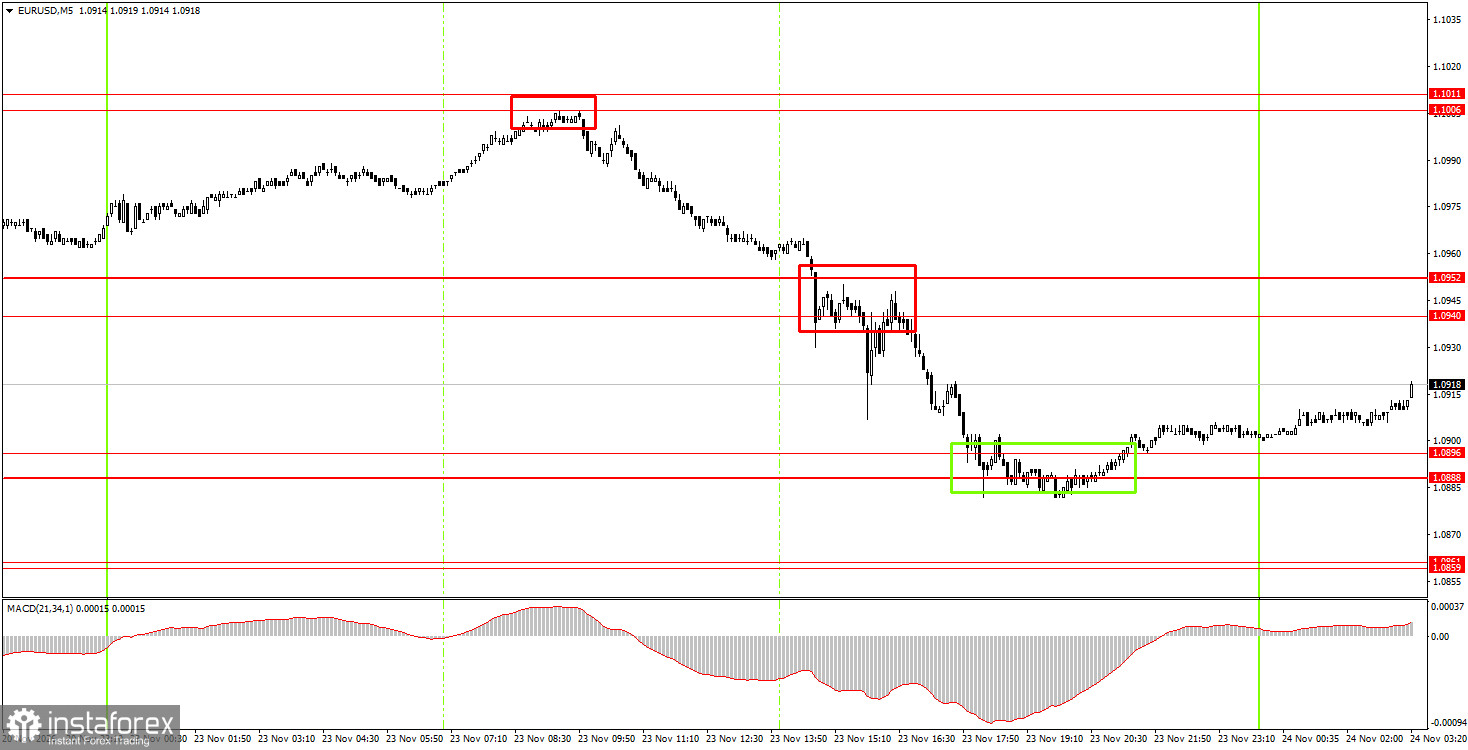
On the 5-minute TF on Monday, three trading signals formed, each producing profit for traders. During the European session, price rebounded precisely from the 1.1006–1.1011 area, allowing traders to open short positions. Next, price breached the 1.0940–1.0952 area and probed the 1.0888–1.0896 zone. Price then bounced from that lower area, giving traders a reason to open long positions.
On the hourly timeframe, the EUR/USD pair continues to form a downtrend that has lasted more than three months. The euro has not managed a single meaningful correction during this period. Considering recent months' events, we do not believe the euro had grounds for such a severe fall with virtually no retracement. At present, the dollar looks heavily overbought, and many factors supportive of the euro are being ignored.
On Tuesday, novice traders may consider new short positions on a rebound from the 1.0940–1.0952 area, targeting 1.0888–1.0896. Long positions can be held after yesterday's bounce from 1.0888–1.0896, targeting 1.0940–1.0952.
On the 5-minute TF consider the levels 1.0797–1.0804, 1.0859–1.0861, 1.0888–1.0896, 1.0940–1.0952, 1.1006–1.1011, 1.1104–1.1114, 1.1198–1.1218, 1.1267–1.1275, 1.1366–1.1377, 1.1461–1.1474. On Tuesday, Germany will publish its business-climate index, the main scheduled event for today. However, Monday showed that the market is prepared to keep buying the dollar regardless of fundamentals and macroeconomics.
Price levels (areas) of support and resistance — levels that serve as targets when opening longs or shorts or as sources of signals.
Red lines — channels or trendlines that display the current trend and indicate the preferred trading direction.
MACD indicator (14,22,3) — histogram and signal line — an auxiliary indicator that can also be used as a source of signals.
Important speeches and reports (listed in the news calendar) can strongly affect a currency pair's movement. Therefore, when they are released, one should trade as cautiously as possible or step aside to avoid a sudden price reversal against the prior direction.
Beginner forex traders should remember that not every trade can be profitable. Developing a clear strategy and money-management rules is the key to long-term success in trading.


