
See also


 31.08.2026 09:42 AM
The new week promises to be informative and, accordingly, volatile. This volatility will arise not only from the busy economic calendar but also from the unique "echo" of Kevin Warsh's speech at Jackson Hole. His rhetoric, in essence, can be interpreted from different angles: on the one hand, the Federal Reserve Chair clearly indicated that the fight against inflation is not over, while on the other hand, he effectively left the door open to decisions that would align with incoming economic data.
It is important to note that most market participants perceived Warsh's speech as hawkish (judging by the dollar's dynamics on Friday). Indeed, the Fed Chair stated that current inflation in the U.S. remains too high, which means the question of further monetary policy tightening remains on the agenda. Given the persistently elevated inflationary pressures, this signal seemed quite logical: the core PCE index in July remained at the June level, at 3.3% year-on-year, significantly above the Fed's target.
However, overshadowed by this statement, in my opinion, was Warsh's key message—that further decisions by the American central bank will primarily depend on incoming macroeconomic data. In this context, inflation is an important but not the only parameter. It is worth remembering that the U.S. labor market is showing signs of cooling, while the growth rate of the American economy slowed to 1.5% year-on-year in the second quarter, following a 2.1% increase in the first quarter. Therefore, if this week's releases fall into the red zone one after another, Warsh's stance of "primarily looking at macro data" will take on new meaning—one that might work against the dollar.
That is why the first week of September will be significant for the EUR/USD pair, as the ISM manufacturing and services indices, the JOLTS report, and ADP data will be released in the coming days. Finally, the August Non-Farm Payrolls will be published. Essentially, the dollar will face several consecutive tests, with the last one potentially being decisive.
The first serious test for the American currency will be the ISM indexes. On Tuesday, September 1, the August manufacturing index will be published in the USA. In July, this indicator unexpectedly rose to 55.6 points, setting a new high for the year, so even a slight decrease will not indicate a worsening situation. The current forecast suggests a minimal decline in the index to 55.2 points.
However, in the current context, much more important will be not only the "headline" figure itself but also its internal structure. In particular, the market's main focus will be on the employment component, new orders, and the price index. The latter was at 71.1 points in July, which is significantly above the neutral 50-point mark, indicating persistent price pressure. Therefore, a strong ISM combined with a high price component could again reinforce hawkish expectations, providing additional support for the greenback. But if the inflation component sharply declines contrary to predictions, the dollar will come under pressure, even if the headline figure meets the forecast level.
On Thursday, the ISM services sector index will be released. Here, the consensus also does not anticipate a sharp deterioration: the forecast is around 54.1-54.4 points, against July's result of 54.1.
In other words, the basic forecast scenario suggests that the American economy remains in the zone of sustainable growth. But if both indexes turn out to be significantly below expectations (i.e., closer to the "red line" of the 50-point value), the market will receive the first serious argument that the U.S. economy is indeed starting to lose momentum. And this would be a direct confirmation of the second part of Warsh's "Friday message."
An even more significant block of macroeconomic data in the upcoming week will concern the state of the American labor market.
The first significant release will be the JOLTS report for July, which will provide an assessment of labor demand and labor market stability. In June, the number of job openings was 7.36 million, down from the previous figure of 7.54 million. This time, the forecast suggests a further decline to approximately 7.33 million. If the actual figure does indeed decrease, it will signal a gradual cooling of labor demand. Special attention should be paid to the number of hires and layoffs, as well as the dynamics of voluntary resignations. The combination of these components will help assess how stable the labor market remains.
On Wednesday, the ADP report will take the baton, often seen as a "harbinger" ahead of the Nonfarm Payrolls. According to the previous report, in July the U.S. private sector created only 44,000 jobs, indicating a rather modest hiring rate. Forecasts suggest that in July, ADP will show a weak result of 47,000. Therefore, any value significantly below expectations is likely to intensify pressure on the dollar ahead of the main macroeconomic event of the week - the August NFP report.
The upcoming Nonfarm Payrolls can indeed significantly "repaint" the fundamental picture for the EUR/USD pair. Let me remind you that in July, the American economy unexpectedly lost 23,000 jobs instead of the expected increase of approximately 85,000. According to most analysts, only 58,000 jobs were created in August (a very modest employment gain). At the same time, unemployment should remain at the June level, that is, 4.1%.
However, the unemployment figure cannot be viewed in isolation from the dynamics of the labor force participation rate, which decreased to 61.4% in July. If the unemployment rate remains at 4.1% in August but the share of the economically active population declines again, the dollar will come under pressure. This would mean that the unemployment rate is maintained only due to a further reduction in the labor force: Americans, for one reason or another, are leaving the labor market and are no longer counted as unemployed. In fact, this mechanism was observed in July, which is why unemployment remained at the previous month's level.
Therefore, in Friday's report, it will be important not only the level of unemployment itself but also the factors that cause it to change or remain the same. If employment increases, unemployment remains stable, and the share of the economically active population increases, this will be a truly positive signal for the dollar. But if unemployment remains low solely due to a further reduction in the labor force (and weak employment growth), the greenback will again come under pressure - and quite significantly.
As a result of his resonant speech in Jackson Hole, Warsh has essentially left the final word to macro data. By identifying inflation as a problem, he simultaneously emphasized the dependence of further policy on other key indicators. Therefore, weak macro data can not only neutralize Friday's hawkish effect but also "reverse" it completely. If the ISM, JOLTS, ADP, and, most importantly, Nonfarm Payrolls indicate further cooling of the labor market, the market's focus will quickly shift from the prospect of interest rate hikes to the risks of slowing American economic growth. For the EUR/USD pair, this will be a serious argument in favor of recovery after the sharp decline on Friday.
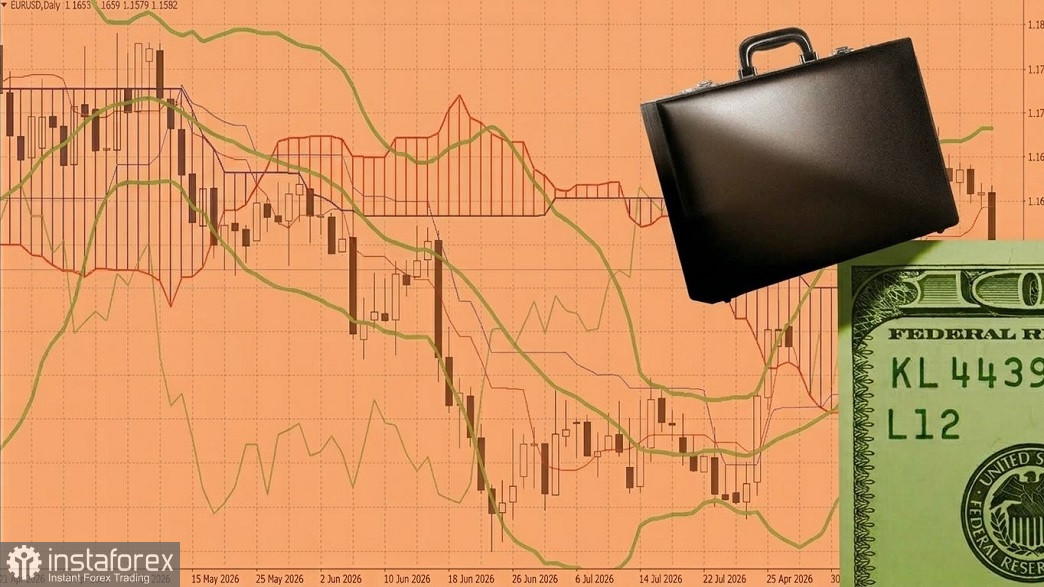
From a technical perspective, the pair failed to break through the support level of 1.1580 at the end of Friday, which corresponds to the average line of the Bollinger Bands indicator on the D1 timeframe and simultaneously to the average line of the BB on the W1 timeframe. If buyers hold this support level, they will likely return to the 1.1640-1.1680 range, within which the pair traded for almost the entire past week (up to Friday). A confident break below 1.1580, on the other hand, will open the door to the next support level of 1.1530 (the upper boundary of the Kumo cloud on D1) and, in the long term, to the psychologically significant mark of 1.1500.


