
See also


 11.11.2026 09:23 AM

On Tuesday, November 10, Ethereum's price was again in the spotlight — the token slid to the $2,000 mark. The release of US inflation data proved a cold shower for the market: inflation exceeded expectations and bets on a Fed rate hike strengthened significantly.
Against this backdrop, the largest altcoin suffered the blow — Ethereum broke the $2,100 level and lost nearly 5% on the day (CoinGape via CryptoNews), while Bitcoin fell below $74,000 (Cointelegraph). Fortune estimates that Ethereum has dropped about 16% over the past month and roughly 41% over the past year.
The trend of capital outflows from institutional products only makes things worse. US spot Ethereum ETFs recorded outflows of $365.3 million for the week ended November 6 — the sixth consecutive week of outflows.
Since the start of October, investors have pulled about $2 billion from these funds, according to SoSoValue data cited by BeInCrypto on Yahoo Finance. The largest recent outflow hit BlackRock's iShares Ethereum Trust — roughly $346 million last week (Crypto Times). October was especially painful: net outflows for the month reached a record $1.61 billion (Decrypt on Yahoo Finance).
Leverage played its part: more than $1.15 billion of crypto positions — mostly longs — were liquidated in the 24 hours before November 10 (Altcoin Buzz). Another roughly $200 million was wiped out within an hour after the inflation data release (Yahoo Finance).
The CME FedWatch tool showed a high probability (88.3%) after the release that the Fed will raise rates by 25 basis points at the December 9 meeting; the chance of a 50-basis-point move was put at 11.7%.
Earlier the same day, Fed governor Christopher Waller said a 50-basis-point increase "should be considered" if core inflation exceeds expectations (Cointelegraph).
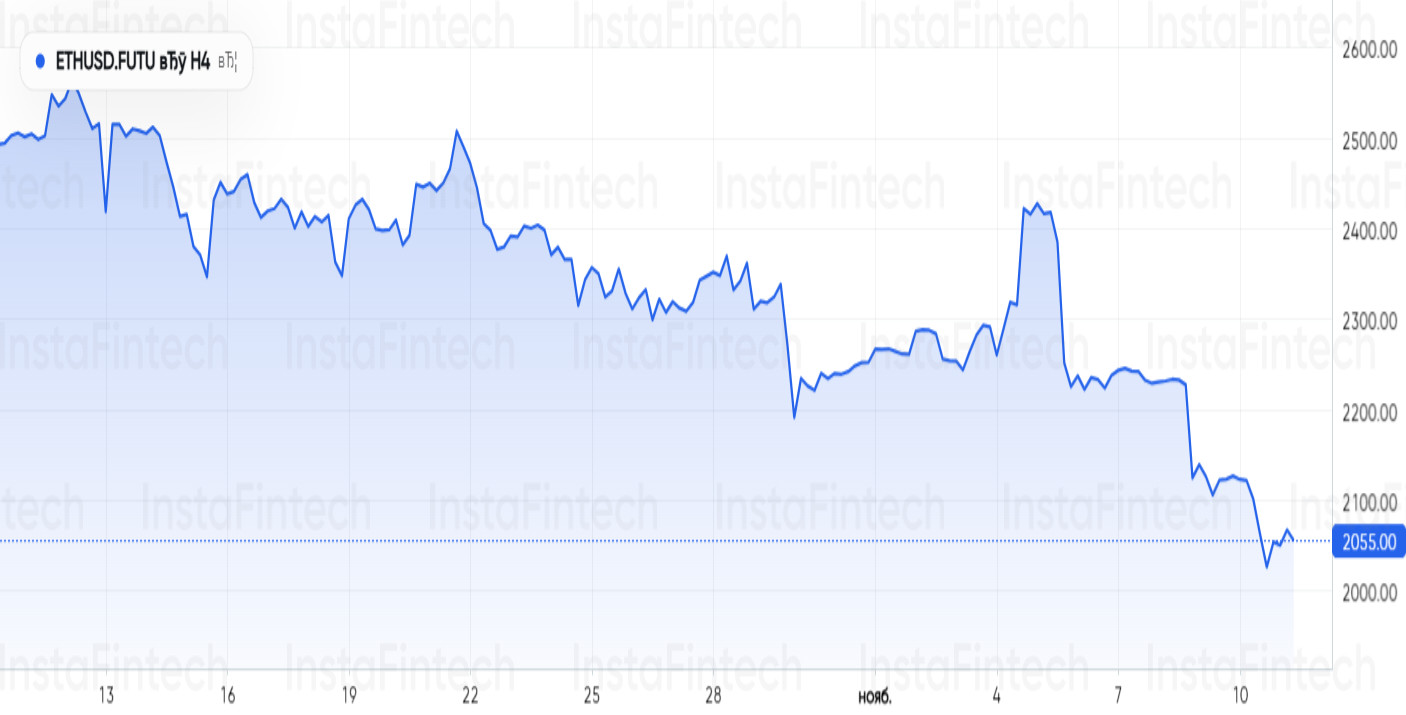
Analysts note that Ethereum's losses are not accidental and have technical confirmation. Salah-Eddine Bouhmidi, expert from IG Europe, said that since August, Ethereum has given back a significant portion of its gains and is now trading below the 100-day moving average.
He called the $2,000–$2,039 zone a key support. In his scenario, holding that level could lead to a bounce to $2,333, while a confirmed break below $2,000 would open the way to around $1,877 (IG).
At the same time, industry leaders voiced cautious optimism. Fundstrat chairman Tom Lee attributed the weak current price action to "market impatience" but pointed to fundamental growth drivers: the steady development of asset tokenization — much of it built on Ethereum — and Vitalik Buterin's view of ETH as a store of value.
Tom Lee believes the crypto bull market is only beginning and that capital inflows into the sector are far from exhausted, including interest driven by AI technologies. "All of this adds up to an optimistic outlook for the next 24–36 months. Buckle up," he wrote (CCN).
Last week, mining company Bitmine bought 9,587 ETH, bringing its balance to 6,070,092 tokens (The Block) — a sign that large holders continue to top up positions despite ETF-related selling.


