
Veja também


 05.06.2026 08:58 AM
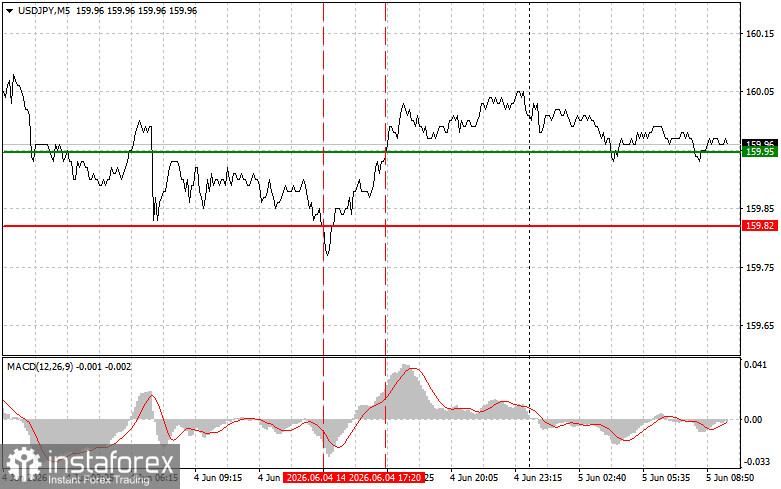
The price test at 159.95 occurred when the MACD indicator had moved significantly above the zero mark, which limited the pair's upward potential. For this reason, I did not buy the dollar. A similar situation was observed with short positions at the price of 159.82.
With the USD/JPY pair returning to the level of 160, discussions about potential currency interventions by the central bank are increasing. According to recent data, it is evident that Japan has used its foreign securities reserves, including US Treasury bonds, to finance a record-scale intervention in the currency market. According to data released by the Ministry of Finance on Friday, Tokyo's holdings of foreign securities at the end of May decreased by $75.6 billion from April. This scale corresponds to Japan's recent market intervention to support the yen. The Ministry confirmed last week that the volume of interventions for the month ending May 28 reached a record 11.73 trillion yen. However, this provided only temporary support to the yen, which weakened again against the dollar and returned to the 160 level, from where the central bank may act more aggressively again. It is advisable to continue monitoring the sales of long-term Japanese bonds and to expect new aggressive measures from the regulator to support the national currency.
Regarding the intraday strategy, I will rely more on implementing Scenarios 1 and 2.
Scenario 1: I plan to buy USD/JPY today when the entry point reaches around 160.06 (green line on the chart), with a target of 160.35 (thicker green line on the chart). Around 160.35, I plan to exit the long positions and open short positions in the opposite direction (expecting a movement of 30-35 pips back from the level). It is best to return to buying the pair during corrections and significant pullbacks in USD/JPY. Important! Before buying, ensure that the MACD indicator is above the zero mark and is just beginning its rise from there.
Scenario 2: I also plan to buy USD/JPY today if there are two consecutive tests of 159.84, with the MACD indicator in the oversold area. This will limit the pair's downward potential and lead to an upward market reversal. Growth can be expected at the opposite levels of 160.06 and 160.35.
Scenario 1: I plan to sell USD/JPY today only after the price reaches 159.84 (red line on the chart), which will trigger a rapid decline in the pair. The key target for sellers will be 159.49, where I intend to exit shorts and open immediate longs in the opposite direction (expecting a move of 20-25 pips back from the level). Sellers will return at any moment; we just need a hint from the central bank. Important! Before selling, ensure that the MACD indicator is below the zero mark and is just beginning its decline from there.
Scenario 2: I also intend to sell USD/JPY today if there are two consecutive tests of 160.06 while the MACD indicator is in the overbought area. This will limit the pair's upward potential and lead to a market reversal downwards. A decline can be expected to the opposite levels of 159.84 and 159.49.
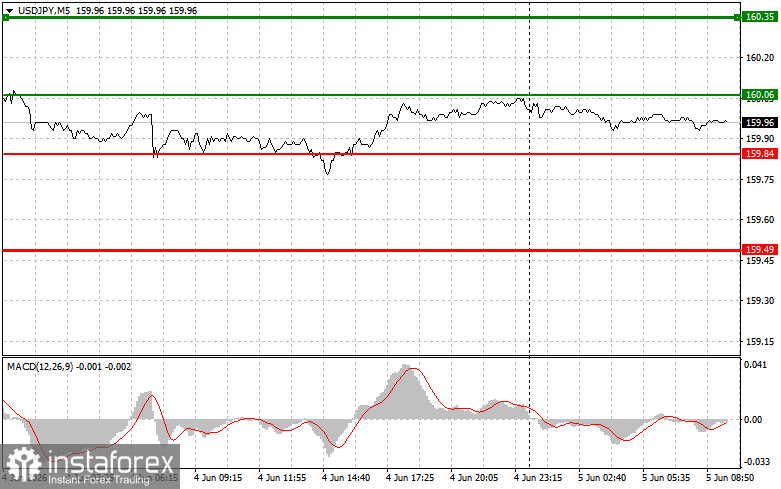
Thin green line – entry price for buying the trading instrument;
Thick green line – presumed price level for placing Take Profit or manually securing profits, as further growth above this level is unlikely;
Thin red line – entry price for selling the trading instrument;
Thick red line – presumed price level for placing Take Profit or manually securing profits, as further decline below this level is unlikely;
MACD Indicator. When entering the market, it is important to consider the overbought and oversold zones.
Important: Beginner traders in the Forex market must be very cautious when making entry decisions. Before major fundamental reports are released, it is best to stay out of the market to avoid being caught in sharp fluctuations. If you decide to trade during news releases, always set stop orders to minimize losses. Without setting stop orders, you can quickly lose your entire deposit, especially if you are not using money management and are trading large volumes.
And remember, for successful trading, you need a clear trading plan similar to the one presented above. Making spontaneous trading decisions based on the current market situation is inherently a losing strategy for intraday traders.


