
Vea también


 16.07.2026 05:21 PM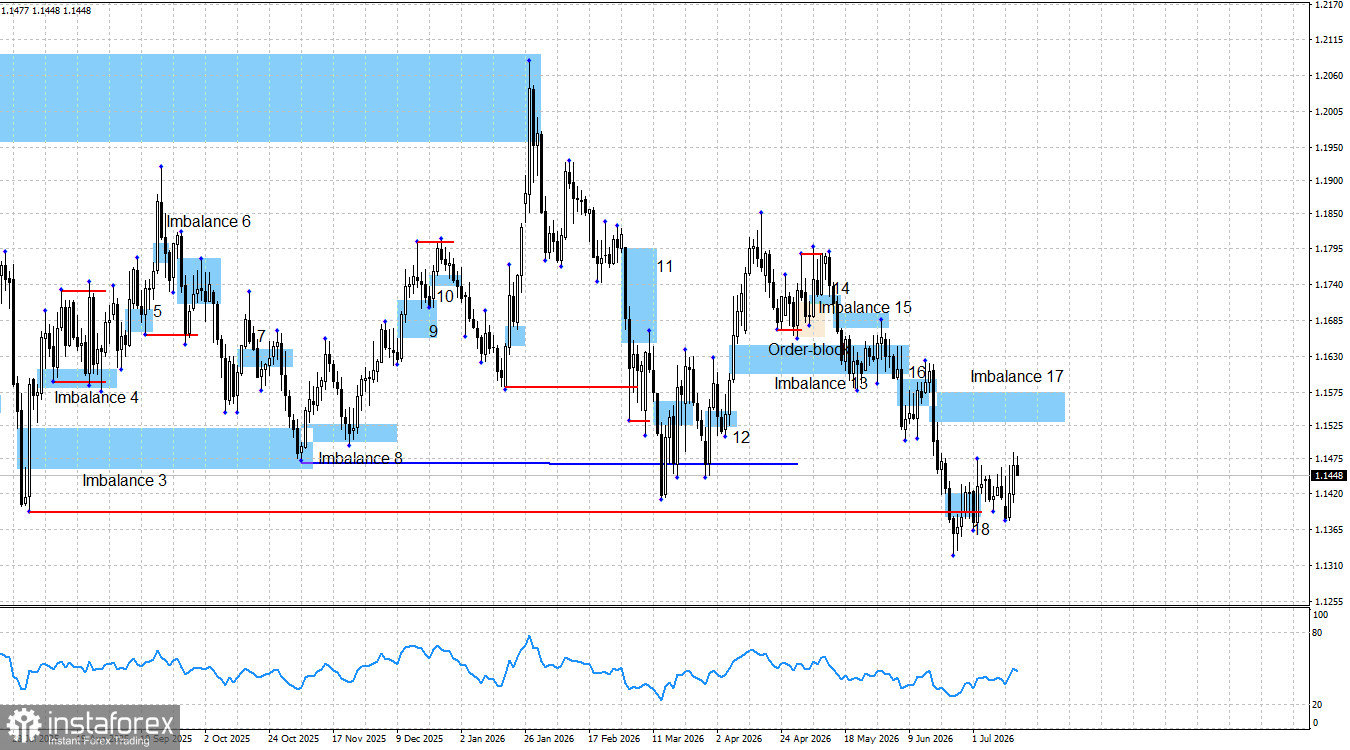
EUR/USD remains within a local bearish impulse, while over the past three weeks buyers have managed only to push sellers back slightly. The euro's gains have been modest, but even limited appreciation is preferable to another decline. Buyers have launched an advance, yet the euro's further prospects will depend on geopolitical developments, inflation, and signals from the Federal Reserve.
This week, it became known that U.S. inflation slowed to 3.5% year-on-year, rather than the 3.8% expected by the market, significantly reducing the likelihood of further monetary tightening by the Federal Open Market Committee (FOMC). I do not believe this means the Fed has abandoned the possibility of another rate hike, but inflation still slowed by 0.7 percentage points in a single month.
Federal Reserve Chair Kevin Warsh also testified before Congress. As expected, his rhetoric remained largely unchanged from the Fed's press conference a month earlier, with continued emphasis on the challenge of elevated inflation. However, market participants had anticipated a more hawkish tone and did not receive it. As a result, the U.S. dollar has found little support this week, although buyers of the euro have also been reluctant to act aggressively. In my view, the situation remains rather unusual. The dollar continues to strengthen—or at least avoids weakening—under almost any circumstances.
It is also worth recalling that the latest U.S. labor market data were relatively weak. Job creation remained subdued, with employment growth over the past three months totaling roughly 100,000 fewer jobs than traders had expected. Consequently, the combination of a slowing labor market and easing inflation is forcing the FOMC to assess the need for further monetary tightening much more cautiously.
Geopolitics has moved into the background. Last week, Tehran and Washington once again violated the terms of the ceasefire and the June 17 agreement, but this development came as no surprise to market participants. U.S. President Donald Trump signed an executive order revoking authorization for Iranian oil exports, reinstated restrictions on Iranian shipping, while Iran once again closed the Strait of Hormuz and resumed attacks on vessels attempting to pass through it.
The market failed to react when the conflict de-escalated and therefore has shown little reaction to its renewed escalation. We did not see the widely expected weakening of the U.S. dollar as geopolitical tensions eased, nor did we see the euro strengthen following the European Central Bank's tighter monetary policy. Sellers therefore remain in a strong position despite the broader fundamental and geopolitical backdrop. At present, renewed geopolitical tensions provide bears with formal justification for fresh selling pressure, although in my view the market is reacting to the same geopolitical developments for the third time—including events that have not yet actually occurred.
The current technical picture continues to point to the persistence of the bearish impulse that began on April 17. Bearish Imbalance 17 has not yet been mitigated, while Imbalance 18 was invalidated following weak U.S. labor market data. No bullish price patterns have formed, and none are likely to emerge over the next few days as the market remains largely range-bound. Consequently, buyers may continue a corrective advance toward Imbalance 17, but there is currently no technical basis for trading that move.
It is also worth noting that liquidity has been swept below the August 1 low from last year (marked by the red line on the chart). At present, this remains the only technical signal offering support to buyers.
Thursday's economic calendar was relatively uneventful. Neither buyers nor sellers made any decisive moves during the session. U.S. retail sales and initial jobless claims data failed to generate any meaningful market reaction.
There are still numerous reasons for buyers to regain control during 2026, and even the conflict in the Middle East has not diminished those arguments. From both a structural and long-term perspective, President Trump's policies—which contributed to the sharp decline in the U.S. dollar last year—have not fundamentally changed. At present, I see few strong factors supporting the dollar despite the FOMC's hawkish stance. EUR/USD is approaching a series of significant lows and swing points where liquidity may be swept, potentially providing a signal for a reversal of the current bearish impulse.
Eurozone
United States
The economic calendar for July 17 includes five scheduled releases, none of which I consider particularly significant. As a result, macroeconomic data are likely to have only a limited impact on market sentiment on Friday, mainly during the second half of the day.
In my view, the pair remains in the process of forming a bullish trend. Although the fundamental backdrop shifted sharply in favor of sellers four months ago, the broader uptrend cannot yet be considered invalidated or complete. Therefore, buyers may launch another advance after liquidity has been swept below the clearly defined lows. However, opening long positions at this stage is not advisable. Bullish technical patterns should form first to confirm the scenario.
At present, traders have only Bearish Imbalance 17 to work with. Liquidity has already been swept from the latest swing lows, while the fundamental rationale behind the U.S. dollar's strength remains questionable. Therefore, I continue to expect a bullish recovery, but it is important to obtain at least some technical confirmation before acting on that scenario. Alternatively, traders may wait for a fresh sell signal to emerge within Bearish Imbalance 17.


