
See also


 29.10.2026 05:41 AM
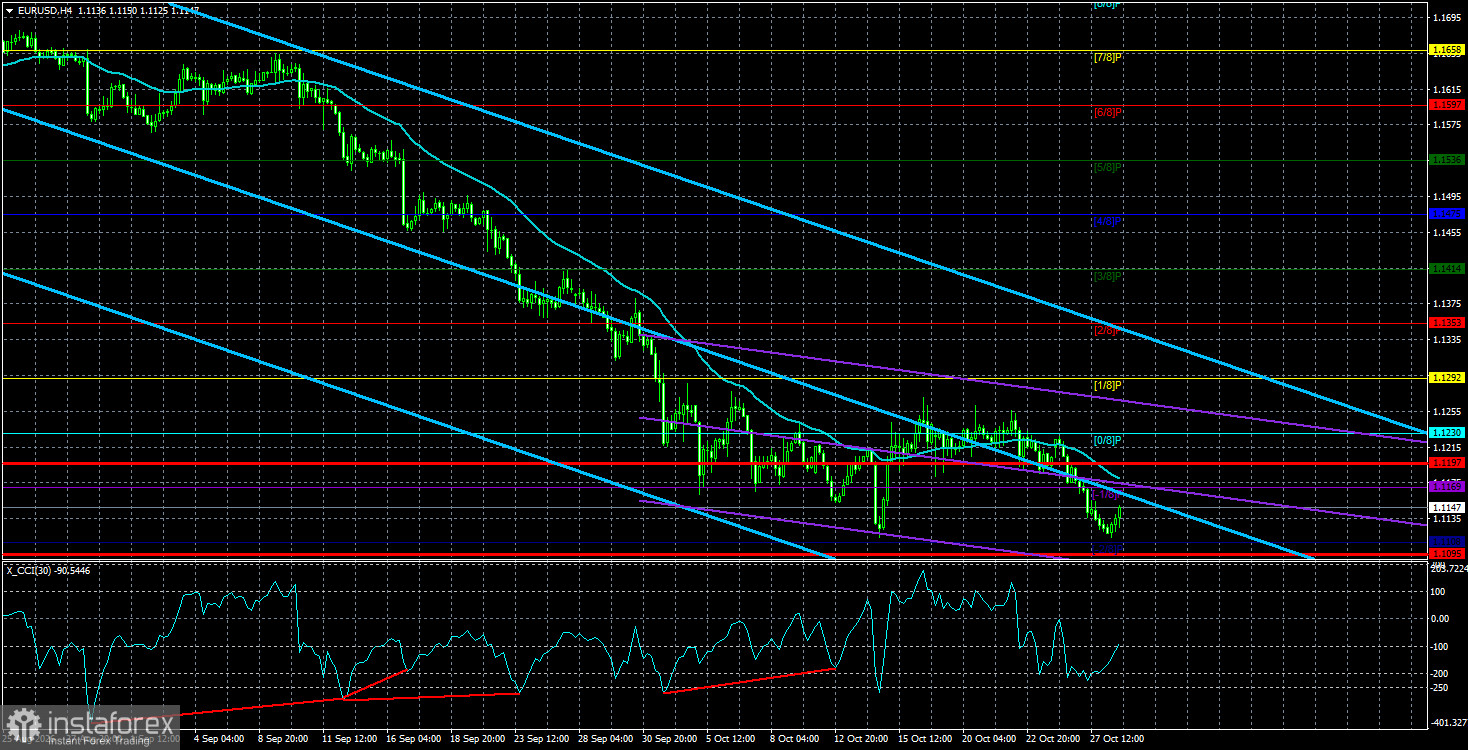
The EUR/USD pair calmly continued its decline for most of Wednesday. Traders, meanwhile, spent their time reading "Tales of 1,000 and 1 Nights" across the internet and specialist sites. We do not believe anyone in the market today can confidently say the dollar's rise over the past two months is fully logical or justified. Recall that at the start of the year, most analysts predicted further dollar weakness. What has changed in the last nine months apart from the U.S.–Iran war and its consequences? Earlier, the market expected dollar weakness because of Trump's protectionist policies, his pressure on the Federal Reserve, the trade war he fostered, a slowing U.S. economy, and many other reasons.
Some of those factors have indeed been neutralized in 2026. For example, the U.S. economy may show about 3.5% growth in Q3 — hardly a sign of slowness. Yet public debt has risen to $40 trillion, and the U.S. budget remains in deficit. Many analysts claim Bitcoin will keep rising because of high U.S. public debt. So Bitcoin rises, and the dollar... rises as well? Such explanations only show an obvious fact: many experts say what suits them (as with Bitcoin) or selectively pick factors to justify a move that has already happened. If you polled economists two months ago about dollar expectations, few would have predicted a 600–700-pip rise.
Today, the European Central Bank will announce its decision. It is already known the ECB will hold rates unchanged, yet the euro has plunged for days and for two months as if dropped off a cliff. The Fed holds rates unchanged, and the ECB holds rates unchanged — yet only the euro falls, and has been falling for two months. What explanation can we invent now, when unrest in some countries has eased, and the Middle East war has not resumed?
An explanation has emerged: the ECB is supposedly "dovish," while the Fed is "hawkish." The ECB does not change policy rates, but its tone is "dovish." The Fed also does not change policy rates, but its tone is "hawkish." The ECB is expected to hike in December, but its rhetoric is "dovish." The Fed is also expected to hike in December, yet it is "hawkish." And that is all one needs to explain the dollar's current rise.
We continue to believe this is an inertial, speculative move that needs no rational justification. In short: the dollar rises because it is being bought, and it is bought because it is rising. This is purely profit-seeking trading. There is currently no meaningful link between fundamentals/geopolitics/macroeconomics and the EUR/USD moves.
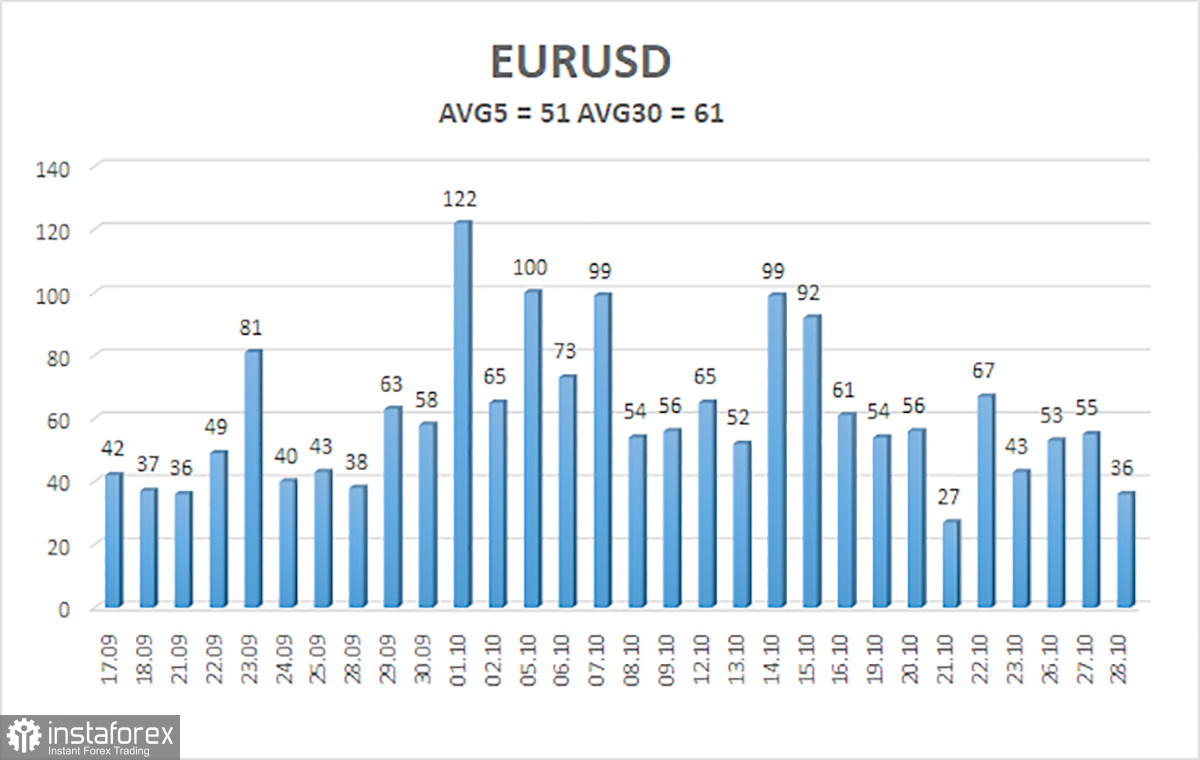
The average volatility of the EUR/USD currency pair over the last 5 trading days as of October 29 is 51 pips, characterized as "average." We expect the pair to trade between 1.1093 and 1.1199 on Thursday. The higher linear-regression channel has turned down, indicating another trend change. The CCI entered the oversold area five times and formed four bullish divergences, warning that the illogical downtrend may be ending. However, the market has reacted weakly to these technical signals so far.
S1 – 1.1108
R1 – 1.1169
R2 – 1.1230
R3 – 1.1292
The EUR/USD pair continues to move downward, but we still view the decline as a correction before a new uptrend. The global fundamental backdrop for the dollar remains negative, but in 2026, geopolitics, followed by the Fed's hawkish stance, provided strong support for the U.S. currency. When price is below the moving average, consider short positions targeting 1.1108 and 1.1093. Above the moving average, long positions are relevant, with targets at 1.1292 and 1.1353.


