
See also


 06.11.2026 08:45 AM
The euro and sterling ended Thursday lower, though both currencies climbed notably in the Asian session. EUR/USD fell to 1.1197 after a morning high near 1.1270, and GBP/USD trades around 1.3425 after a peak near 1.3500. The picture turned against risk asset buyers, and the main reason was a sharp selloff on U.S. equity markets.

The Nasdaq lost more than 6% amid renewed anxiety over the artificial intelligence sector, and traders preferred Treasuries. Notable is how quickly market logic shifted: on Wednesday tech giants added almost $1 trillion of market value on expectations that Democrats would slow data center buildouts and thereby ease corporate cash flows, but fears about AI quickly regained the upper hand. U.S. Treasury yields plunged, prices rose, and the dollar strengthened. Recall that on Wednesday 10-year Treasuries traded near 4.84%—the low since September 10—and then falling yields pressured the dollar. Today the same yield decline is occurring for a different reason—demand for safe havens—so the dollar benefits.
Yesterday's U.S. labor data did not materially move markets despite being strong. Weekly initial jobless claims were 189,000 versus a 197,000 forecast and 195,000 the prior week, matching the lowest levels since 1969. Continuing claims were slightly worse than expected at 1,718,000 versus 1,710,000. Nonfarm labor productivity in Q3 rose 3.6% (forecast 2.8%; prior 1.4%), and unit labor costs fell 0.7% versus an expected 0.3% rise. This is the first decline in labor costs since the middle of last year and therefore a disinflationary signal for the Fed, but it was ignored in yesterday's Treasury market move.
Additional support for the dollar came from Fed speakers, notably Beth Hammack. She said policy will need to be restrictive to bring inflation back to 2% and that she prefers more frequent but smaller rate moves. Compare with October 12, when similar comments from Hammack pushed EUR to monthly lows; on October 28, she voted for a hike in a 10–2 split. The rhetoric remains hawkish, and Thomas Barkin backed a gradual pace of hikes. I believe the market now largely prices a December Fed hike, and attention is shifting to next year and how far the Fed is prepared to go.
The Bank of England met yesterday and raised the policy rate to 4.00% from 3.75%, as expected. The decision was firmer than anticipated: the vote was unanimous, 9-0-0, compared with a 3-0-6 split in September, and analysts had expected seven votes for a hike. Governor Andrew Bailey said a second hike is more likely than not if energy prices return to prior levels and added that inflation is likely to remain elevated because of the Middle East conflict. He argued inflation will not fall as quickly as previously expected given Britain's price cap mechanism for energy. Yet the pound failed to sustain the earlier bull run that began on October 28, and the risk of its liquidation is now significant. Why did the hike not support the currency? I think the move was fully priced in, and the market judges the probability of a further December step at roughly 50/50.
This episode reiterates that major central banks are in hawkish mode and that rates are unlikely to change direction soon. The ECB keeps the deposit rate at 2.50% and prices the next 25-bp step for December 17. Robert Knoop, a candidate for the ECB presidency, recently warned the central bank will have to counter fresh inflationary shocks with a hawkish policy. One external risk remains: oil is recovering after a recent decline amid an unclear pause in U.S.–Iran talks, and if the situation does not improve, oil will likely rise further, increasing pressure on the euro and sterling.
Turning to the calendar, today's European releases include German industrial production and orders, French industrial production, Italian retail sales, and eurozone producer prices. German orders draw attention after a prior 10.6% slump and an expected near-5% rebound; French industrial output is forecast to return to +0.4% after -0.3%. PPI refers to September and is unlikely to change the picture materially: month-on-month PPI is forecasted to be +2.5% after +1.9% in August, and year-on-year PPI is at +10.9% versus +8.2% previously—very high producer inflation, which the euro may react to, though today's focus is likely elsewhere.
Most attention will shift to the U.S. labor market for October. Unemployment is expected at 4.2% (it rose to that level in September after 4.1% in July and August). Nonfarm payrolls are forecast to rise by about 65,000 after a sharp 29,000 in September; August was revised to +133,000, so 65,000 should even out the recent cadence. Average hourly earnings are expected to be +0.3% month-on-month after +0.1% and +2.9% year-on-year after +3.0%. If the data beat, dollar demand is likely to persist into the end of the week, and we would see further downside in EUR and GBP. The preliminary University of Michigan consumer sentiment index for November is expected near 48; watch inflation expectations. Fed speakers Alberto Musalem and Michelle Bowman will comment on the already published data.
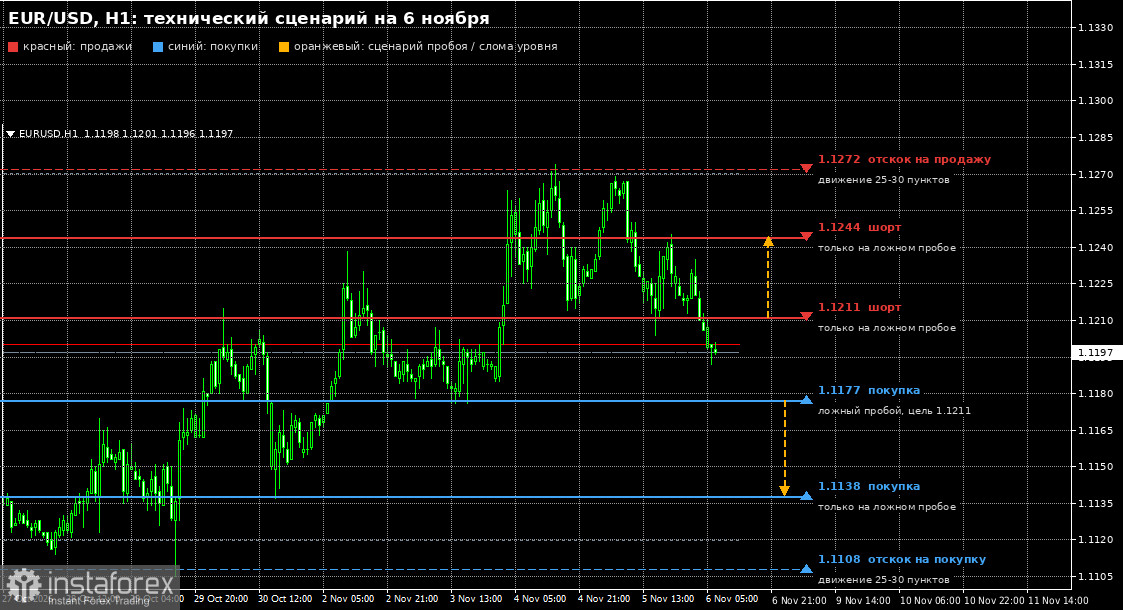
Technical picture for EUR/USD (hourly chart)
For buyers I see 1.1177 as the first level: a false break on the downside can be used as a long entry toward 1.1211. A break and hold above that range would extend recovery to 1.1244, and the weekly high near 1.1272 is the next target where I will look to short bounces for 25–30 pips. Short positions on rallies from 1.1211 and 1.1244 are viable only on false breaks. If bulls do not appear around 1.1177, euro downside pressure will likely intensify, and strong U.S. labor data could open the way to 1.1138 and 1.1108, where I would consider buying the rebound for 25–30 pips. Longs from 1.1138 and 1.1177 are acceptable only on false breaks.
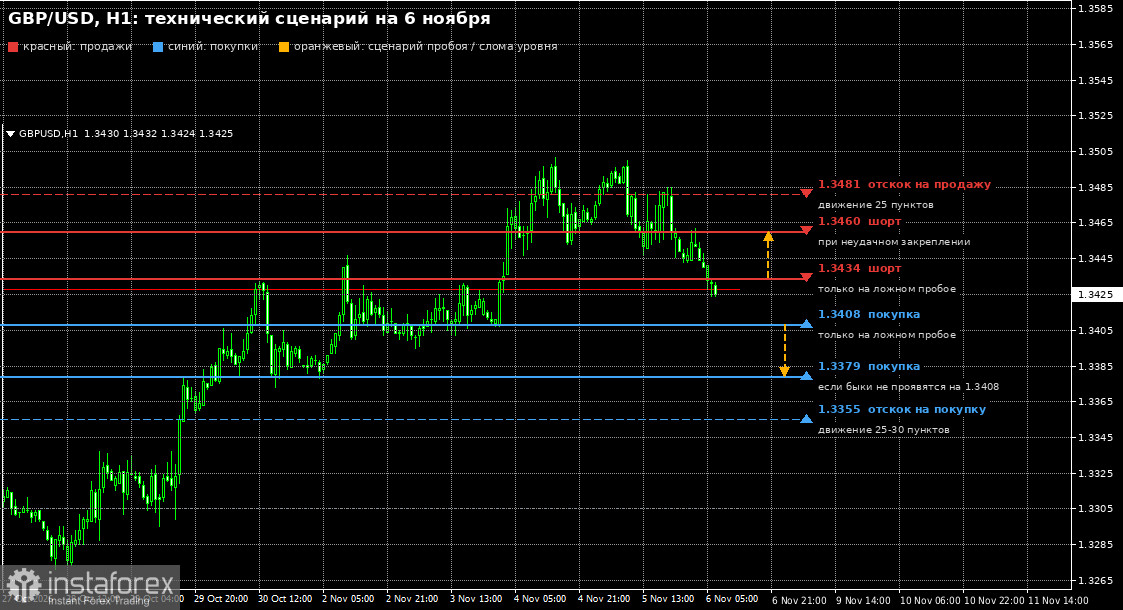
Technical picture for GBP/USD
The setup is similar. First bullish presence I expect around 1.3408 on a false break, or buys from 1.3379, with bounce entries from 1.3355 targeting 25–30 pips. For shorts, try 1.3434 on a false break; beyond Bank of England speeches, no other major U.K. data are scheduled today. If sellers do not appear at 1.3434, look for more aggressive shorts at 1.3460 on failed holds, or sell the bounce from 1.3481 for about 25 pips.


