
Vea también


 30.10.2026 09:17 AM
Gold is trading again below $4,000 per ounce and is set for a second consecutive monthly decline. Spot gold fell about 0.6% to $3,982 after losing nearly twice that yesterday. For October, the metal is down almost 4%. Silver dropped 1.3% today to $51.47, and platinum and palladium also fell.
The reason is rising inflationary pressure while the Federal Reserve has not closed the door on rate hikes. On Wednesday, the central bank held rates but left the possibility of further increases later in the year. Yesterday's data reinforced those expectations: the Personal Consumption Expenditures price index — the Federal Reserve's preferred inflation gauge — rose 0.5% month-on-month in September, the fastest monthly pace since March. The year-on-year reading came in at 3.6% versus the Fed's 2% target. For non-yielding gold, every such print makes it more expensive to hold than bonds.
Oil is feeding inflation. Prices rose on signs the U.S. may resume strikes on Iran after next week's congressional elections. Brent has nearly doubled year-to-date and traded between $113 and $116 this week. High energy costs squeeze consumers and force central banks to stay hawkish — through this chain, pressure on oil, inflation, and interest rates transfers to the metal.
The second threat comes from equities. Tech stocks led a global sell-off for a second session after another round of disappointing earnings, and investors continued exiting AI trades. This echoes last week's scenario, when the AI sell-off pulled gold down to its July lows because traders sold the metal to cover equity losses. Since then, gold has oscillated around $4,000, and dip buying by Chinese households and long-term investors has so far prevented a deeper fall.
However, many analysts believe the metal is still holding up reasonably well. Traders are watching whether last night's sell-off will spill into today's U.S. session, because that could trigger broader deleveraging and forced selling across markets as liquidity dries up. If that happens, gold could become a source of cash again rather than a safe haven, as it did last week.
Silver looks noticeably weaker in this story. It fell nearly to $51, losing about 15% in October and wiping out the entire gain from December's rally, which briefly pushed it above $120. The gold-to-silver ratio has climbed to its highest since December—meaning one ounce of gold now buys more ounces of silver than at any time since then.
My view is that in the coming days gold will remain around $4,000 with a downward bias. As long as oil stays expensive, U.S. inflation doesn't retreat, and the Fed is poised to hike in December, the metal has little reason to rally convincingly, and any new wave of equity selling could push it back into weakness. Only cheaper oil, softer price dynamics, and falling yields would be likely to reverse the trend — and none of those conditions are visible yet. In my view, silver will lose ground to gold if liquidations continue.
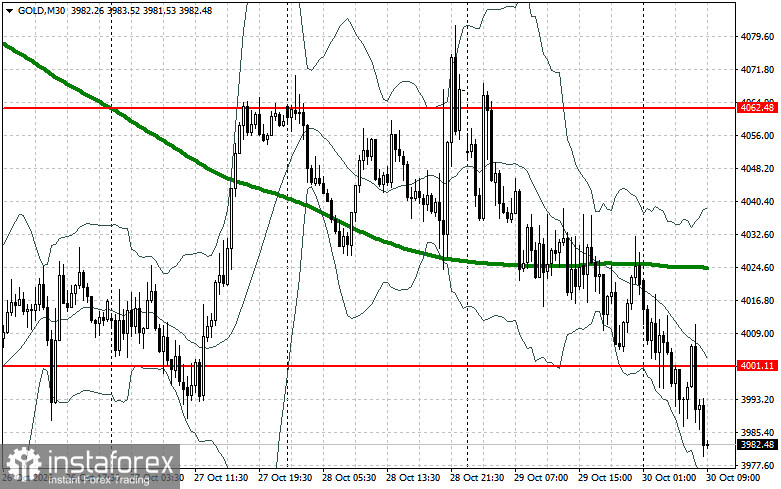
Technical picture: buyers need to take the nearest resistance at $4,062 to target $4,124, above which a breakout will be difficult. The farther target is the $4,192 area. On the downside, bears will try to seize control of $4,000; if they succeed, a range break would deal a heavy blow to bulls and push gold toward $3,954 with the prospect of extending to $3,906.


