
Veja também


 13.10.2026 09:32 AM
Losses across global equity markets intensified amid fresh AI fears that pushed investors out of one of the year's hottest segments. Treasuries rallied on safe-haven demand. The Asia-Pacific MSCI index fell by 1.6%, and South Korea's Kospi, a key barometer of the AI trade, plunged by 6% on worries about competition from China. SK Hynix shares dropped by about 10%, while Samsung Electronics lost roughly 8%. US and European index futures also traded lower.
The Asian sell-off extended into Wall Street. The Nasdaq 100 hit a one-month low, and the US chip-makers index reached its weakest level since mid-September. This is a reversal after Monday's bounce, when S&P 500 futures gained 0.3%. With Korea breaking a key technical support, concerns are rising that pressure on the tech sector will last longer than a couple of sessions.
The root cause is growing doubt ahead of the US earnings season. AI enthusiasm has cooled as investors question whether massive spending will pay off under higher borrowing costs — and after a four-year bull market that has lifted the S&P 500 roughly 120% from the 2022 low. Bears now dominate much of the AI segment, and sentiment is as negative as it has been in a long time.
Warnings are mounting. Broadcom's CEO said that the boom attracted investors whose strategies resemble gambling and who may not understand what they are betting on. Last week, Ray Dalio labeled AI a classic bubble at risk of bursting because of rising interest rates and the need to convert valuations into cash. Pressure is intensified by competition: reports say that Chinese firm CXMT has advanced in developing higher-capacity memory architecture.
The bond market is telling a different story. The 10-year US Treasury yield fell by 4 basis points to 5.20% after markets reopened from the holiday. It was 5.31% on October 8 and approached 5.4% last week, the highest since 2002. Oil has reinforced the case for bonds: Brent eased by 0.9% to $105.70/bbl after trading above $105 on Monday morning.
In my view, tech-sector pressure will likely persist in the near term, with the Kospi and chipmakers among the most vulnerable. Stocks need strong earnings and a cautious tone on capex to turn the tide. Absent that, bonds will remain the main beneficiary of the flight to safety, and the 10-year yield is more likely to test 5.1% than to return to 5.4%. A renewed oil spike above $106 or a strong US inflation print could re-pressure bond markets and spread the sell-off across equities.
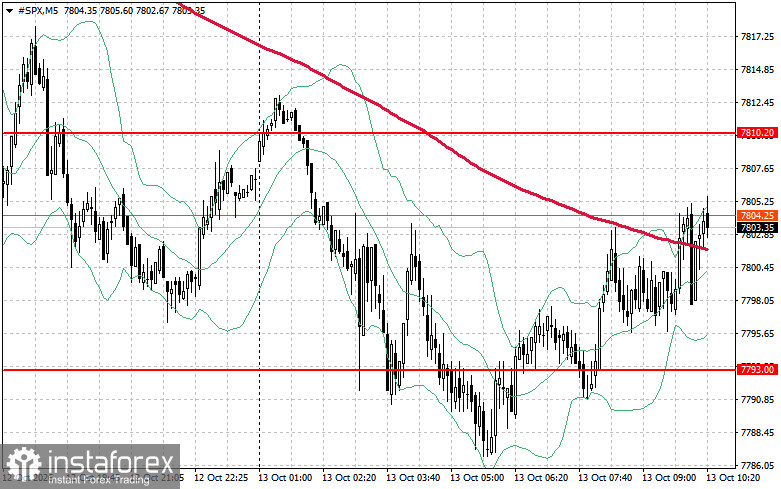
As for S&P 500 technicals, the immediate task for buyers is to overcome the resistance level of $7,810. That would signal upside and open the way to $7,824. Holding $7,841 is also a priority for bulls to strengthen positions. If the price moves lower amid falling risk appetite, buyers must show up near $7,793. A break below that level would likely push the index down to $7,774 and open the path to $7,756.


